“Mentorship in this community often looks like someone noticing you, giving you a small nudge, and then stepping back so you can figure out your own way in.”
~ Lindsey Dono
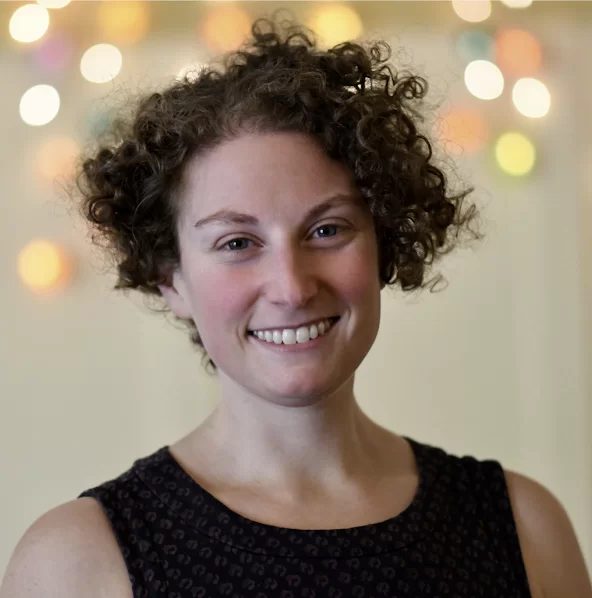 Lindsey Dono
Washington-based caller Lindsey Dono is a mainstay on the national contra circuit, and has been on staff at camps, weeks, and festivals for over a decade. Known for precise teaching and welcoming stage presence, Lindsey crafts programs with rich narrative arcs. Both on stage and off, Lindsey is committed to building inclusive, intergenerational folk communities.
Show Notes
Sound bites featured in this episode (in order of appearance):
- Lindsey calling the dance “Susie’s Send-Off” by Scott Higgs with music by Audrey Jaber and Alex Cumming at the Lake City Contra Dance in Seattle on April 17, 2025.
- Lindsey calling the dance “Labor of Love” by Kathy Anderson with music by Pachelbel’s Bazooka (Claude Ginsburg, Dave Bartley, and Anita Anderson] at the Emerald City Contra Dance at Phinney Neighborhood Center, in Seattle, Washington on February 3, 2023
Other things!
- Lindsey’s very own website. Make sure to check out:
- Dance choreography!
- Hear more wisdom from Lindsey and others in this great online workshop from CDSS: The Caller’s Toolbox: Gender-free Calling for Contra Callers
- Check out a recent story from KNKX Public Radio featuring Lindsey and others from the Seattle dance community.
Dance Notation
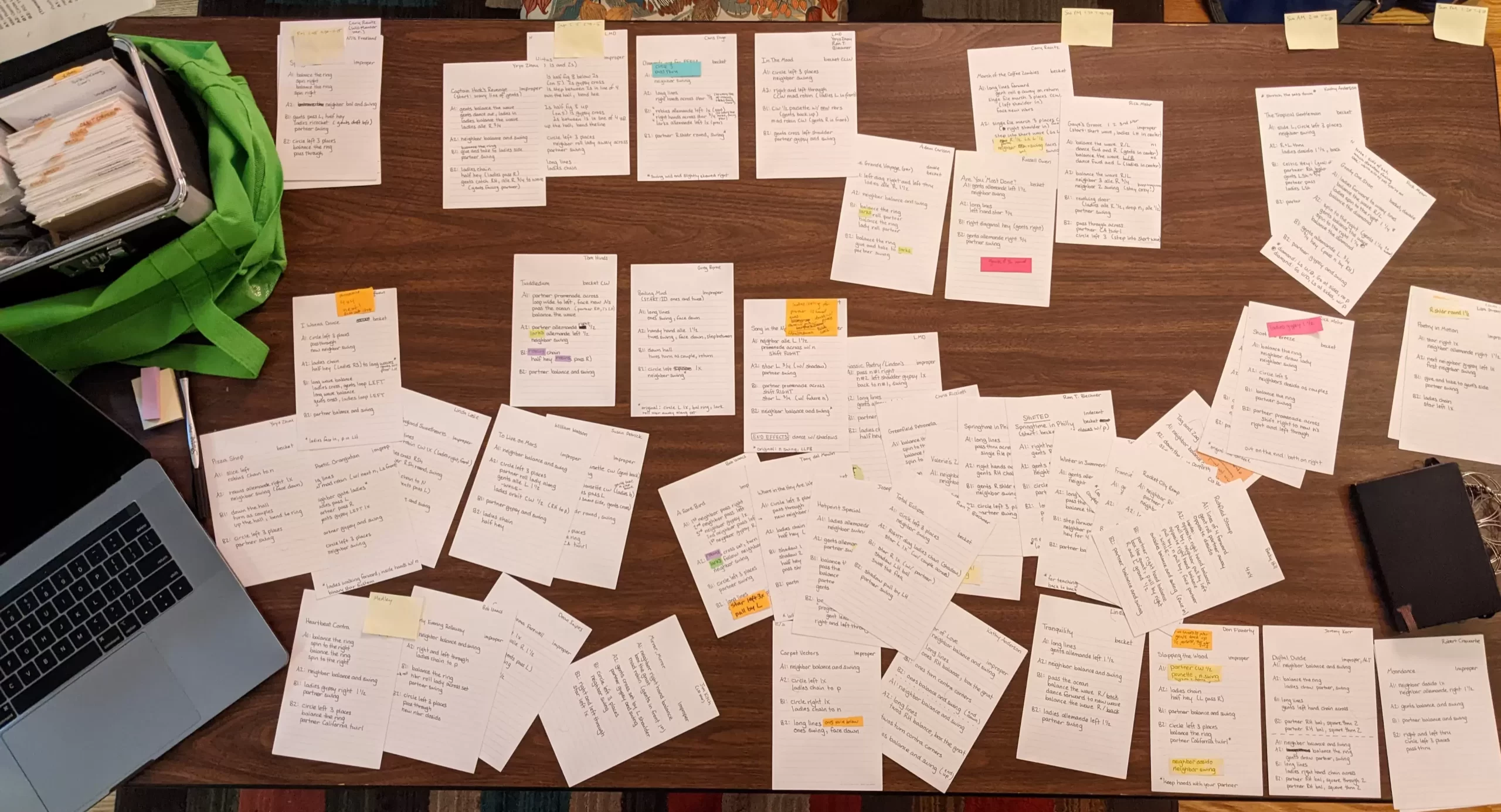
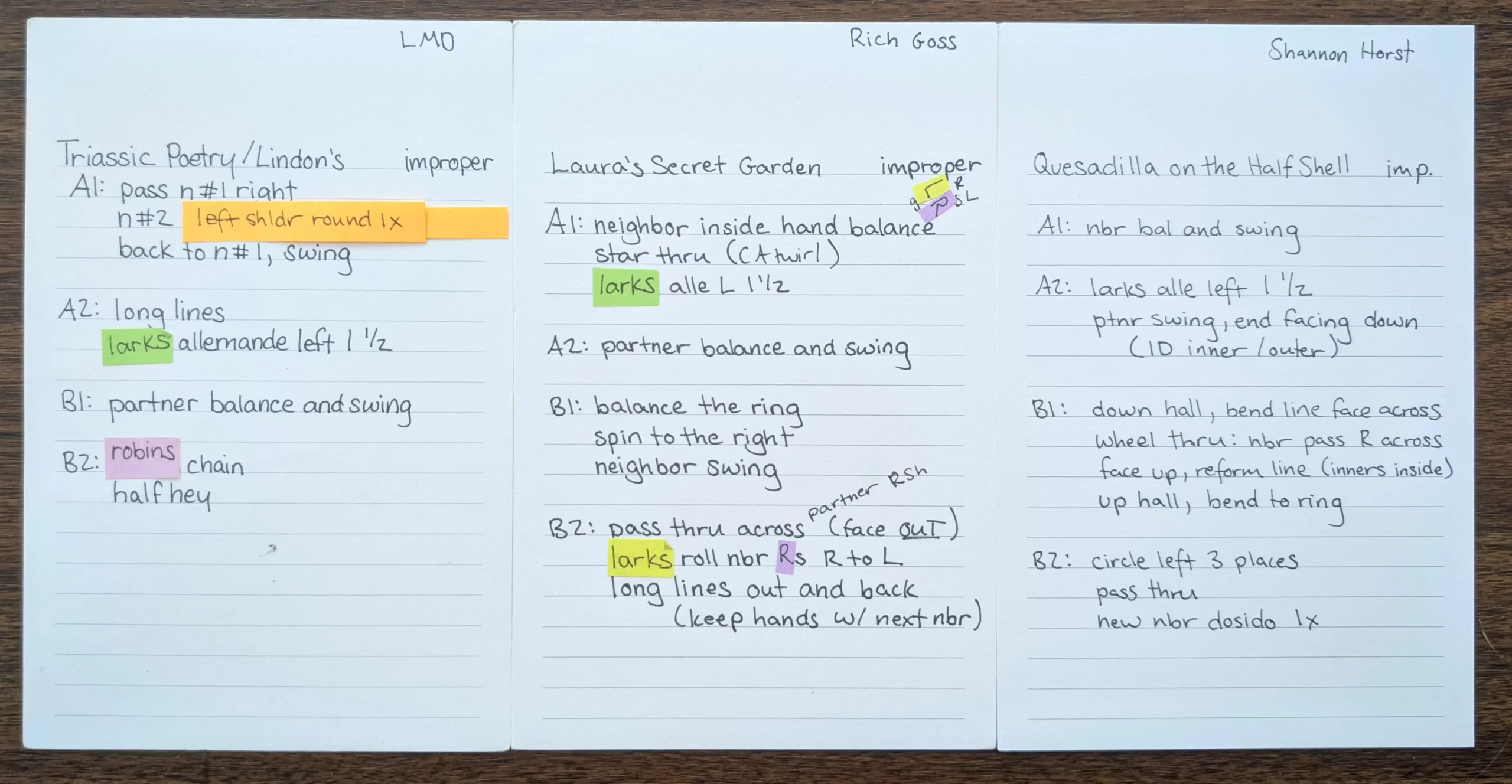
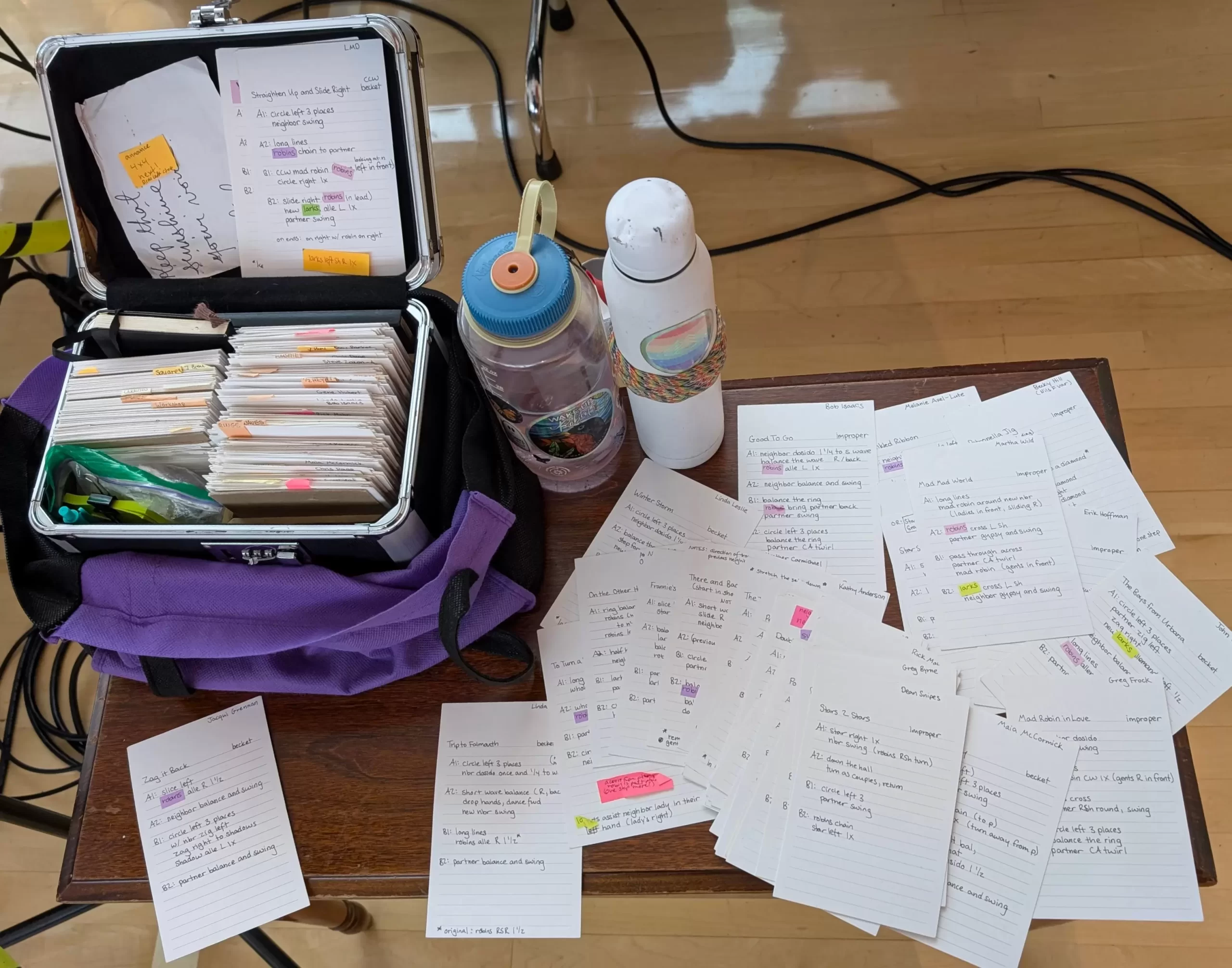
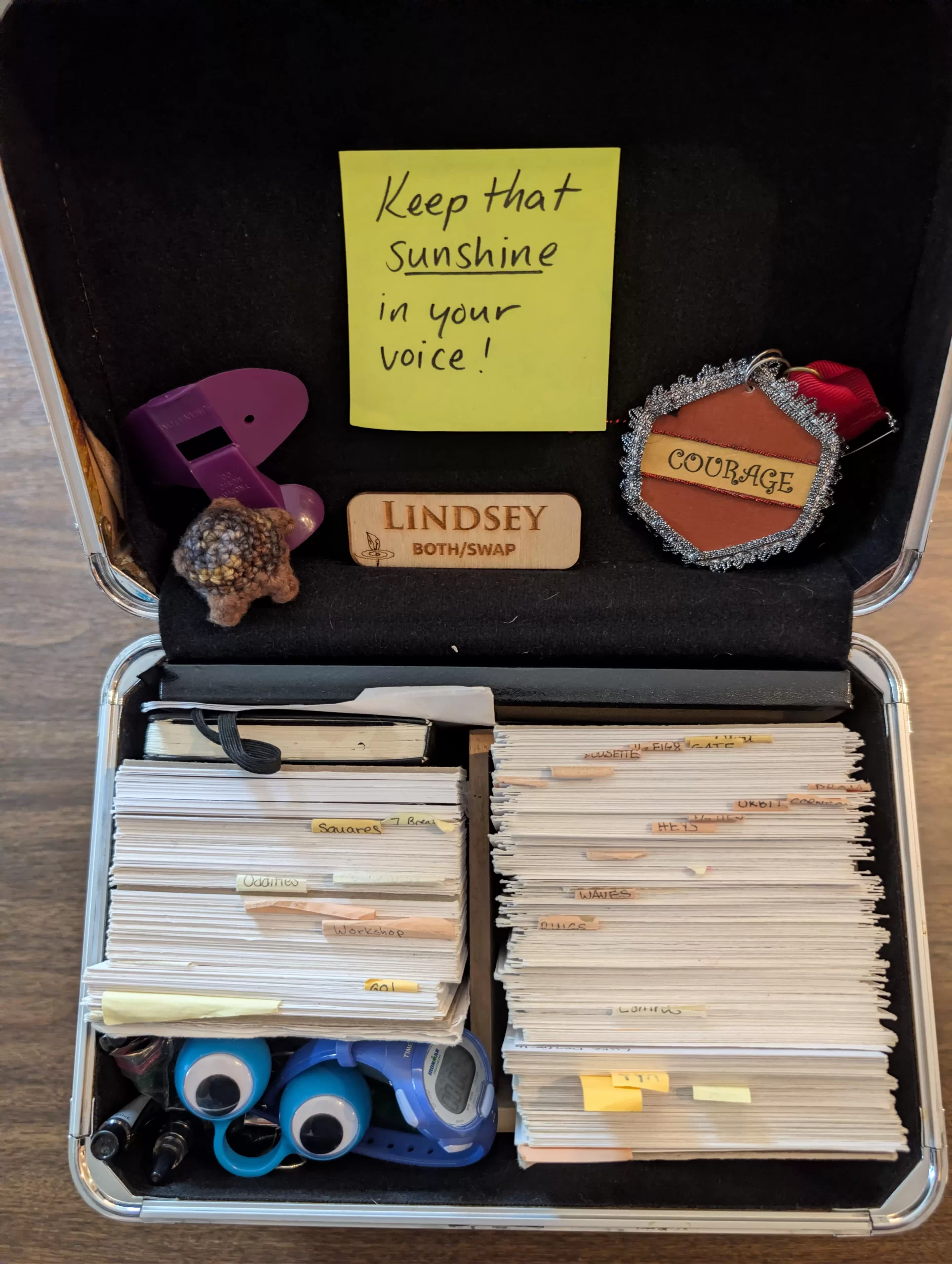
Some pictures of Lindsey’s dance cards – with some things to note from Lindsey:
- I am paper-first, but have photo backups of all my cards stored in the cloud.
- Rather than rewriting hundreds of dance cards with gender-neutral role terms, I cut up colored sticky notes to amend the cards. Now, I am so attached to the colors I had arbitrarily associated with each role that I get nervous if I see a card without any color on it!
- My cards are organized by key figure, based around a templatized approach to programming I devised for myself and share in my calling workshops/with others I mentor.
- In addition to utilitarian odds and ends, I keep several quirky trinkets in my box, including a ‘courage’ badge given to me at the first dance camp I called, a crocheted ‘Tim the Turtle’, and a nose flute. I also have a reminder from a mentor to ‘keep that sunshine’ in my voice.
[ Click on images to enlarge ]
Episode Transcript
Click here to download a transcript.
FTM Ep 32 – Lindsey Dono – Transcript
Mary Hi everyone! It’s been a minute! It’s me, Mary Wesley, here at long last with a NEW episode of From the Mic. We took the summer off and I’m glad to be bringing you some new caller conversations to cozy up with as the seasons turn.
Today you’ll be hearing from Washington-based caller Lindsey Dono! Lindsey is a mainstay on the national contra circuit, and has been on staff at camps, weeks, and festivals for over a decade. Known for precise teaching and a welcoming stage presence, Lindsey crafts programs with rich narrative arcs. Both on stage and off, Lindsey is committed to building inclusive, intergenerational folk communities.
In our conversation, Lindsey shares how they got their start calling thanks to a little friendly peer pressure, and how their background as a behavioral scientist shapes the way they think about calling — from how dancers learn to how communities move together. We talk about balancing dance calling with a full-time job, the art of crafting a program that tells a story, and how curiosity and community service keep Lindsey returning to the mic. Lindsey also shares insights from their work on a CDSS community survey, and what that data tells us about the evolving landscape of traditional dance today.
Oh — and, they’re also the only guest ever to offer me a haiku biography, so I had to include that too:
Lindsey calls dances
And attempts to be succinct
So here’s a haiku.
Here’s Lindsey!
Introduction
Mary Lindsay Dono, hello and welcome to From the Mic.
Lindsey Hi Mary, delighted to be here.
Mary As we’ve just been discussing, this is our first time meeting. It’s our virtual meeting, but I, for one, have certainly been aware of you in the dance universe for many years, have heard your name, seen your name on posters and such. I’m also aware that we have mutual connections with CDSS. I obviously create this podcast with their support, but lo, so many years ago, got to be a CDSS youth intern and did fun things within that wonderful organization. I was really interested in your work with the recent survey, interested in engaging multi-generational perspectives. So, you know, a few things in common, but I’m very glad to actually get to talk to you face to face and get to know you a little bit. So thanks for joining us.
Lindsey Absolutely. And it does feel completely ridiculous that we haven’t really crossed paths or interacted before this and hopefully this is the start of many conversations.
Mary I agree. Yes. Well, to start us off, would you tell us where you’re speaking to us from today, and just introduce yourself? Maybe talk a little bit about how you got into the world of traditional music and dance, and eventually to the caller’s mic?
Lindsey Sure. So I’m speaking from Tacoma, Washington—that’s the state, in the Pacific Northwest. I grew up in eastern Massachusetts, and that’s also where I first discovered dance through contra and my introduction was in high school through some friends who’d been members of Village Harmony, and they had had a little tiny Village Harmony…the occasional DIY dance, and some of my friends had started contra, or kind of community dancing in that space. And while I had enjoyed the singing and being adjacent to the shape note community, they said, “Well, we think you’d really like the dancing. You should come to a dance.”
And so being in high school and needing to get rides from somebody, one of our moms drove us to what ended up being one of the very last dances at the old Cambridge VFW hall. We showed up at the break and my friends very helpfully introduced me to a swing and a hey-for-three and threw me right in after the break. The first dance was one of those multi-person, pull-by along the set dances. I ended up tragically out of place, and I had so much fun. So throughout high school in the Massachusetts area and in Vermont, I contra danced through high school; moved west to Portland, Oregon for college, found a dance community there. And while I was in college, one of the local callers, whose name is Rich Goss, handed me a piece of paper one day and said, “We’re having an open mic in two weeks, you should call this dance.” I looked at the paper and I looked back at Rich and I said, “What do those numbers on the side mean?” And Rich said, “That’s how many beats there are per move.” And I went, “There’s beats per move?” I had some homework to do, so that’s how I got started.
Mary Amazing, a direct ask. Have you asked Rich, or do you know why he asked you specifically?
Lindsey Rich locally has a well-deserved reputation for being the instigator of new talent, both for musicians and for callers, and has been an incredible resource to not just me, but many other people in the Pacific Northwest who he will identify as potential leaders and gently make space for them. I was pretty reluctant and just kind of went with the flow for quite a while and was very, I guess, non-directed about where I could go or wanted to go with calling but knew that I loved to dance and was deeply involved across, not just contra, but some other styles as well.
Mary And backing up a little bit, I mean, Village Harmony is obviously an amazing space for young people to connect with traditional music. Were there other ways that you were involved growing up with music happening in your family? Or was the traditional music and dance scene sort of a new shiny thing to you?
Lindsey It was entirely a new thing that I had discovered through friends. My parents were kind of…”What is this thing you’re doing? And everybody’s wandering around barefoot and tie-dye. Where are you going on Thursday nights? This Concord Scout House thing? You can borrow the car, but, you know, come right home afterwards.”
Mary Yeah, I have a similar experience of, you know, I meet people who grew up dancing, did it in diapers, and I discovered it after college. I’m always in awe of folks who kind of grew up in the water, but also grateful for how fun it was to discover this whole amazing world.
Lindsey And then I talk to people who discover dance in their 60s and they look at me or you and go, “Wow, I wish I started as young as you did.” So have you passed your dance half-life? Where you’ve been dancing more than half your life?
Mary Wow, I’ve never thought of that. I’m 41 and I started dancing…I would have been 22, so I’m getting pretty close. Yeah, getting there.
Lindsey Being the nerd that I am, I took the opportunity to calculate it and put it on my calendar so I knew to celebrate my dance half-life when I reached it.
Mary That is a wonderful thing. You know, like, to the day?
Lindsey To the day.
Mary Wow. Incredible. Well, congratulations! Do you remember your first time at the mic? What dance did Rich hand to you and how did it go?
Lindsey Rich had handed me a variation of Lisa Greenleaf’s “Air Pants,” which is a classic modern starter dance. Neighbor balance and swing, face across, long lines forward and back to Robin’s allemand right once and a half. Partner balance and swing, and then the B2 variation: circle left three places, balance the ring, pass through. Perfectly reasonable beginner dance. I hand it to new callers all the time myself. I got up on the mic, things happened, complete blur, stepped off stage and Rich handed me a second card and said, “Call this one after the break.”
Mary Okay. So Rich has an M.O. here I’m sensing.
Lindsey And so that first dance I’d had two weeks to think about and practice, and at that point there were enough videos on YouTube that I was able to go find Air Pants, and find Lisa calling Air Pants, and really work on my phrasing and my words and my timing. I’m sure I was still quite late. The second dance that I was handed was “The Newlyweds Jig,” which is significantly more complex, both for dancers and for a new caller, and had much shorter phrasing in it. So I remember sitting out during the break frantically transcribing it. Trying to get, “Okay, how many beats is this thing?” I’d never thought about this before. I’d always been one of those very intuitive dancers who just never had to count anything in 4/4. I scripted out how I thought I should teach it. I got on the mic, I said some things, stuff happened and I remember stepping off stage and a very nice older dancer who I was quite close with came up to me and said, “You know, it’s a little bit better if you can call the move ahead of time.”
Mary That’s so nice. Very gentle.
Lindsey It was very gentle and…we were all aware of that.
Mary Yes. Well, it sounds like you had a good community in which to step up to the mic.
Lindsey Yes.
Mary Nice. And what happened from there? You clearly, having gone through that experience, you were willing to keep going, maybe not immediately… What were your next steps?
Lindsey My next step was to start senior year of college. I did not touch anything related to calling until the following summer, at which point this same individual, Rich, said…oh, at that point I had moved from Portland, Oregon up to Tacoma, Washington. Rich sent me an email saying, “I’m calling at your local dance. Would you like to come call one dance?” And so this process repeated for a couple of months and I called a dance in…I guess called for Rich at a Seattle, Washington dance. And the organizer there, Sherry Nevins, approached me and said, “We’d love to have you do more guest slots!” Things start ramping up to half an evening…and the rest was history. I will fully say I was quite reluctant, and did not initiate any of these asks. However, I also didn’t say no.
Mary I note that. Any idea why?
Lindsey Initially, I’ll say two things. One is—and this may be something you’ve experienced as well, being young and socialized female—you don’t say no to things, particularly when people ask nicely. And there was also just that intellectual curiosity of, what does happen behind the stage. Okay, there are those counts or beats per move, what else is there? And so there had been this piece of just…this is something to explore that I’m finding intellectually satisfying.
Mary And when did the reluctance start to lift?
Lindsey People still ask me, do I enjoy calling? And I don’t have a succinct answer and I’ll be totally honest about that.
Mary I love that you say that.
Lindsey For me at this point there’s an element of community service to it and sure, we get paid, tens of dollars. But having reached a place where I can facilitate exuberance and fun and joy and build community, and do it in a way that is effective, I think was something that I’d latched on to.
Mary What else?
Lindsey Well, not so secretly, it means I get to hang out with these really cool musicians. And that, to me, is one of the most compelling aspects of folk dance, and particularly contra. In what other species of activity do you get to really interact with some of the most talented musicians in the world who are playing live music that you’ve requested right next to you?
Mary Yup. Super big perk. Yeah, I mean, I love that you’re just expressing that gray area. Because there is so much that is joyful about being part of making dance happen. And in some ways a caller’s attitude towards what they’re doing is really an important tool and sometimes that can be practiced, and sometimes that can be genuine. And both can be highly effective.
Lindsey It is definitely interesting when I’m either talking to other callers or leading a caller’s class, that there are so many callers who are really enthusiastic about being on stage or having that command of attention. For me, that comes much more from this…I’m a trained behavioral scientist, that’s what I do. And so there’s this really deep and underlying curiosity about, how are people behaving and how can I beneficially influence that behavior? But I don’t feel a need to be on stage and I was never a natural public speaker.
An example I can give you was even in college, I remember this presentation that I’d had to give for a biology class. I remember stumbling my way through it and the professor pulling me aside afterwards and saying, “Are you okay or is this just really not something you’re comfortable with?” And so now to be in a position where, not only am I comfortable being on stage speaking to people, but in my other world as a user experience researcher in the tech field, I am invited to give presentations on how to give presentations.
Mary How about that?
Lindsey So for anyone out there who’s going, “Oh you know, I’m not a natural comedian. I have no standup skills, I’m not good at public speaking.” It can be learned.
Behavioral science and contra dance calling
Mary Absolutely. But I’m always really interested in how people relate to…how callers obviously, relate to the fact of needing to be on stage. Of needing to be on stage as part of the job, right? It’s kind of…you need to be up where you can see the dancers, you need to be amplified and at certain points, you need to have everyone’s attention focused on you. You need to be the center of attention. And then, very quickly, you can become invisible and you kind of go back and forth between those spaces. I’m just always interested in the many different ways that people relate to those factors.
Like you say, some people are all about it. Like, yeah, put me right there in the center. And, you know, you’ve described it a little bit, but will you share more about that? What is interesting to you from that sort of, human observation standpoint of being a caller? I’d love to, if you could say a little more about being a human behavioral scientist, because I don’t know exactly what that means. I have some ideas in my head, but…
Lindsey Sure. So I’ll start from kind of the calling angle here. There’s both the, I’ll say, nuts and bolts behavior of—what words do you need to most efficiently get people to do what you meant and not necessarily what you said, and that’s something that I love working with callers on. And I think an awful lot about, how do we create the most precise set of instructions that achieve the goal of getting people where we want them to be…reaching as many learning styles as possible and also including various accessibility factors. And so that’s kind of like the bare basics.
And then taking a step above that, what are the other factors that may not be on paper that would influence how people are getting from that place to the next place. Is the floor really slippery that night and maybe people are struggling to move around? Is the sound quality not what it could be and everyone’s having a hard time hearing? So thinking beyond just the mechanics of how you’re moving people from one place to the next. And then there’s what’s going on in their heads. What night of the week is it? Is it a weeknight and everybody’s already wondering what are they having for breakfast this morning and how early do they need to get up to get to work? Is it a weekend night and they’re thinking about, where are we going for afters and they’re more in a party mode? Is it cold and raining out? What are all of these other pieces that could maybe, under the radar, be influencing how people are experiencing this moment in dance.
Mary Amazing. So many layers of things to think about and so that’s your job as a scientist too, is to think about all those different factors?
Lindsey So yeah, so my job title is “User Experience Researcher,” and what that means is I’m trying to understand—what are your needs and motivations and behaviors? I do that in an applied way in order to advise how to create a product or an experience. And that’s just what we do as dance callers.
Calling philosophy
Mary I love that. That’s really interesting. And you know, now that you maybe still have some reticence, but have maybe stepped into a more regular role of being a caller, which I surmise you have. You know, what have you learned and what’s your approach and philosophy for dance calling?
Lindsey So there’s a martial art called Aikido. And what Aikido is known for is about directing and redirecting energy. So rather than being an offensive form where you’re trying to attack or you’re trying to directly block or resist something, the kind of ethos behind it is you take your opponent’s or your partner’s energy, observe how and where it’s going, meet them where they’re at, and then slightly redirect it. And that’s really where I see myself as a caller or a community leader is, how can I understand the direction that this community is moving in, join them on that direction, and then think about redirecting or consolidating or funneling that energy in what I see as a mutually beneficial direction.
Mary Beautifully described. Fill us in a little bit on your calling life since Rich came to town and got you up on stage again. How does it fit in your life?
Lindsey Yeah. So I feel like I should be a little bit more gentle about the reticence piece. I’m doing this because there’s something in it for me and something, hopefully in it for everybody else as well. I think my trajectory looks fairly like many others. Where you called in a couple local communities, went from half evenings to full evenings. Something that starts happening, and I encourage others to do this as well as if you can’t take a gig, please recommend the up and comers in your community who could benefit from that stage time. I know I picked up a lot of regional gigs because one of my mentors or someone who knew me said, “Well, I’m booked, but I’m guessing Lindsay isn’t.”
And so I found myself calling in an increasingly wide regional radius and then got my first invitation to call a dance weekend. And then, of course, just that kind of cascade of…you call the one weekend and you get the next invite and the next invite and the next invite. Something that’s particularly interesting is there seems to be a bit of a divide at either the Cascade Mountain Range or the Rocky Mountain range of where people’s kind of calling territories or even music territories ended up being. So I had been very much going north south on the west coast and then had my first invitation off the West Coast. It just felt like my range just kept growing and the limitation really turned into having a full time job and also wanting to make sure that I had space both to dance and to do various other hobbies.
Mary Yeah, how to balance all of that. Nice. I love going back to what you’re saying about about your approach and kind of, directing energy as a caller or sort of perceiving and then guiding and directing. You also mentioned that approach both as a caller and a community leader, and I wonder what that role looks like for you?
Lindsey So let’s say that I’m invited to call somewhere where I haven’t been before or isn’t a community that I feel like I have a lot of knowledge of. I will do my homework ahead of time. In addition to chatting with an organizer, I’ll also look for a dancer in the community and just reach out by email: “Hey, can we have a chat by phone?” It took a while to kind of overcome my millennial tendencies, of…”You don’t call people, that’s really weird.” But in adherence to being a millennial, I did schedule the phone calls.
Mary That sounds very safe.
Lindsey Very safe. And just started asking, you know, “What’s your dance like? What are some people’s favorite dances?” You know, if they knew. Or, what are some figures people like? Anything else I should know about your community? What would you want to tell an out of town caller who didn’t know anything? I’ll also try to talk to another caller kind out on the circuit who maybe called that weekend the previous year, or I know has been through that area. I’ll just start triangulating all that data and go, “Okay, so, well, I’ve never been to this particular city before, it sounds like here’s where the dancers are at. This community tends to trend in this direction. Here are the local callers, here are the local choreographers. And so I can get a sense of kind of what people are dancing or what programming they’re dancing to.
Obviously you can walk in and the situation can be totally different, but at least having that starting point is something that I’ve found helpful. There can definitely be a breakpoint of, okay, you’ve hit data saturation, you just need to show up and see what they’re doing. But having a little bit of that ahead of time, I’ve found has been helpful to at least come in with some sort of an opinion about, what do I want to bring to the community this weekend? What can the community share with me?
Mary How do you understand those goals? What informs them? What are you bringing into it? So, you know, this sense of once you’re tapped into the energy out there what is guiding you in guiding others.
Lindsey One of the most obvious examples is when you get something wrong—and you know this from the stage—there’s something that you do off hand that you’re used to doing in your local community and there’s that sudden, “what?” that you respond to. And through kind of a series of those moments, you can kind of start building that. The other thing that is really important for me to do is to get on the floor and dance if I can. This is something that I really appreciate about two caller events is when I am not calling, as much as I can, I will be on the floor. And that’s not just me getting my exercise for the weekend, it’s reconnaissance.
There’s so much that I’ll pick up of just, okay, well, people, maybe they’re kind of grippy or I’m noticing that there’s this particular way that they’re doing something. A very obvious example is, how do you promenade? And depending on where you are in the country, the default promenade is really different. I called at American Dance and Music Week at Pinewoods this past summer, and I remember Lisa did a poll: who does Skater’s Promenade—two hands low; Who does the Varsouvienne—two hands high for the person on the right; And who does the New England courtesy turn thing? And it was split a third, a third, a third. That was hilarious because it’s the worst case scenario for a caller.
Mary It’s true.
Lindsey Because not only are all the dancers going to be fumbling back and forth, but there’s different choreography that is written assuming different types of promenade holds. That makes total sense in one area of the country and you travel somewhere else and it’s really clunky. So if I don’t get to dance at first, I will call kind of a safe dance, with what I’ll consider a diagnostic figure, and start looking for, “Okay, here’s the default promenade hold.” I also teach social dance, including waltz. If I know I’m doing a waltz workshop, I will really watch what people are doing on that first waltz at the end of the break or before the break. What are people doing? How are they moving? And then think about, okay, how can I take where they’re at and show them a potential next step?
Mary What’s important to you to kind of, invite into the space? And how do you do it? As a caller what are your channels that you tap into?
Lindsey Barebones is safety. If there’s anything that I feel like is physically uncomfortable or unsafe, I will look for friendly ways to bring that to the mic. I travel with a sign. I printed it out, black and white on a piece of paper. It’s a lobster. I’ve taken a big red marker, and I’ve drawn an X through it. I will bring this to every single gig. And what I’ll do is I’ll introduce the space as a “lobster free zone!”
And that’s about the hand clamping. Rather than saying, “Don’t clamp,” I’ll lead with: “This is a lobster free zone.” And everybody looks at me funny and I hold up the sign. “If you look at the stage here,” and I’ll find some regional joke to make about this…like “Clearly we’re in the middle of the country and there’s no water around…” But find a way to not just say, “Here’s what I’m telling you to do,” but then enable people to talk about it.
It is much more comfortable for people to say, “It’s a lobster free zone,” rather than like, “Stop clamping.” Or the—as we’re taught, but don’t always remember—”I need you to X, Y, Z.” So that physical safety, reminding people in figures like waves of just being very cognizant of how you’re connecting with others. And then beyond that, I’ll start building pieces about connection and styling. And again, I certainly have in my head the things that I like to see in dance and want others to enjoy as well. But I really am trying to figure out which pieces are most valuable to bring to a community. There are some places where it’s really just getting through the basics.
[ Lindsey calling the dance “Susie’s Send-Off” by Scott Higgs with music by Audrey Jaber and Alex Cumming at the Lake City Contra Dance in Seattle on April 17, 2025. ]
Leadership
Mary Beyond your caller role and your guidance on the dance floor and around people’s dance experience, are there other ways that you think about being a leader in the community? I think for me, sometimes that means like, are there things maybe off the dance floor, but still kind of within the sphere of a dance community that you think about, and how does or doesn’t that fit into how you think of yourself as a caller?
Lindsey I have been in and out of some official organizer positions, served on a couple of committees. And have also founded and ran—what ended up currently as a one off and hopefully gets restarted—dance camp on the West Coast that was called the “Next Generation Dance Camp.” And that had been inspired by a couple of different events, including YW, Youth Dance Weekend, Queer Camp in the Bay Area in California, and also the Bash on Vashon, which is the northwest New Year’s camp. That had been a moment for me where in truly an organizer and founder role, I had an opportunity and the need to think really intentionally about: what do I want a community to be and what do I want to bring to a community?
And from that experience, which had ended up being way more successful than any of us had hoped—to the point where we’re all afraid to try it again—I realized that while I was good at a lot of the elements of organizing, it really didn’t bring me a lot of joy. And so I’ve found myself more in, I guess, a consultant role because of where I’ve traveled to and the perspectives that I’ve had and just having been around for so long that I just do a lot of ad hoc talking to people. If I had to say like, what is my superpower? It’s dot-connecting. And so being able to take one piece and say, “Well, you know, we’re talking about this issue. I know this other community that’s had something similar come up, you should totally talk to so and so. Can I make you an introduction?”
Something that I’ve appreciated that CDSS has been working on, and this is something that I learned from the survey and both my own experiences, is there’s a ton of resources that are under utilized to really try to do a lot of these pieces, like codes of conduct. And no, CDSS did not pay me to say this, I say this genuinely as somebody who was totally unaware of these resources, ran a survey that showed, “Yes, we’re unaware of these resources.” But being able to connect people to say, “Hey, you’re looking to to build a code of conduct, here’s some resources online and here are the humans behind them. Why don’t you go talk to those humans?”
CDSS Connections
Mary Nice. I’d love to hear more about the CDSS survey. I assume that someone was aware of your role in the dance community and also your day job, I guess, your profession, and said, you know, this is a good combination that this person has.
Lindsey Yeah. So the back story on that was Audrey Jaber had joined CDSS as an employee and we were on stage at gosh, which dance camp was that? Some dance camp. She had mentioned, “Oh, I’m working on this. I had this idea for starting the survey and we really need to figure out what’s going on with our community, particularly our younger members. And that’s kind of what you do, right?” And I said, “Yeah, that’s what I do.” And then I went, “Actually, I have 20 volunteer hours as a company benefit for a nonprofit, I’d be happy to help with this.”
Mary Amazing.
Lindsey Working on that had been this, just absolutely perfect confluence of my interests and my skill sets. And while it was inevitably many, many more hours than the 20 that had been allocated through my work benefit, for me, it had actually just reconnected me with the dance community and helped me reengage in a way that I hadn’t expected. At that particular time, I’d been kind of wondering, “Well, do I really want to keep doing all this stuff? I really like backpacking.” And starting to work on this survey really went, “Wow, I care about this.” And yes, I definitely had to keep my neutral researcher hat on and be kind of that person when CDSS had some motivations or some questions that really you can’t put in a survey per se, but engaging with the results and also having that nice artifact of like, yes, we have a reference for all these things that we’re hearing, let me share it with you, has been really empowering.
Choreography
Mary That’s wonderful. How lucky for you and for CDSS. What other ways do you interact with contra dancing? I believe you have written some dances. Is choreography, something that you’re excited about?
Lindsey I am an incidental choreographer and my compositions have mostly emerged when I have found something that had a gem or a nugget that I found compelling. And to use a jewelry metaphor for this, the rest of the setting wasn’t working for me. So I’d tweak one thing and I’d tweak something else. I call a lot of things that I’ll just say, “This is a variation where I’ve made a couple of modifications,” but not enough that I would consider it a new dance. Sometimes I end up reshuffling things sufficiently and just completely swapping out enough other pieces that it does turn into its own dance.
I’ve had a number of highly engaging and ridiculously nerdy conversations about what percentage of a dance do you need to change to consider it, 1) a variation, 2) a significant variation, and 3) your own dance. So I will save that for some other podcast, but I definitely have a couple of pieces out there that I’ve written. I seem to have a very high success ratio of the number of dances that I’ve written versus the number that have stuck around. I remember the first time that someone had picked up one of my dances and called it, somewhere major. And you get that email afterwards from a friend going, “Hey, your dance was just called at place X.”
I always wish there was a way to put a little tag on a dance and see where does it propagate and how does it get there? There’s definitely the people who will pick up a dance and as they travel and call it, it just kind of starts propagating across different places. I think more than a choreographer, I consider myself one of those, I guess, a pollinator of dances that I pick up dances in places and I bring them somewhere else and I drop them off and I take them somewhere else. It’s always fun to be able to really increase the repertoire by just traveling and calling dances that I think are awesome.
Mary Nice. What do you look for in a dance? What usually catches your attention?
Lindsey My goodness, there’s so many. I think it’s more about what I don’t like. And as I continue to grow my repertoire I’ve become increasingly confident in the things that I don’t like. And so a dance that doesn’t have any of the negatives is something that I pick up. At the moment I’m particularly interested in dances that have one hook to it. That there’s one very unique element that probably is not a stock figure, that would require a little bit more teach from the stage but the rest of the dance is fairly comfortable or we’d consider it glossary figures and something that I could take to many different communities and at a dance with a higher skill level. It could be, just something you throw in, no problem, and at a dance that’s in a different place experience wise it could be that cool dance that you work up to.
Mary What is it about that flavor of dance that you like?
Lindsey I think the universal applicability of it, just being able to take it everywhere. And it’s so easy to collect those really gnarly dance weekend, and not just dance weekend, but that one dance in that one session at a dance weekend dances. They’re labeled in my collection as, “Here be Dragons,” and they are so easy to collect and then they just kind of sit there gathering dust. So finding dances that are fresh and have that one hook to it that you can take everywhere and will be compelling for a majority of dancers is something that I’m desperately looking for more of.
Mary Yeah, that’s gold for sure.And how do you think about programming?
Programming
Lindsey I think of programs as story arcs. That I’m an author or I’m a designer, whatever metaphor you want to use, and we and the dancers, me, the musicians, we’re going on a journey. And we are traveling down a path and I am partially responsible for where we go and how we get there. I know lots of callers say, “Well, I’m thinking about a figure progression.” I think about a figure progression secondarily to an overall flow or feel that I’m trying to craft and I will work backwards into the mechanics from kind of, where the community is at.
Mary You know, we’ve been talking about contra dancing this whole time, but do you call other forms? How do you think about variety or different forms as a caller?
Lindsey So as a caller I primarily call, I’ll say like New England style contras. I have dabbled in community dance. I’ve dabbled in some kind of kids programming. I really haven’t specialized in those, and the people who do that, I have an immense amount of respect for. The hardest gig that I ever had was a six week series at a Waldorf School middle school P.E. class. I’m still afraid that I have traumatized those 18 kids for the rest of their lives. So if any of you happen to be listening, I apologize, I didn’t mean it.
So I’ve been, I would say the majority of my calling experience is in the contra world. The other two directions that I’ll bring up is the social-dance sphere of like, for a lot of other people, contra was a gateway dance for me. “Oh, you like contra? Well, you should come try blues. Well, if you want to be good at blues, you should probably learn East Coast swing but East Coast swing is really about Eight Count Lindy Hop and now that Lindy Hop, how about Balboa Collegiate Shag, Charleston? Well, now you need to pick a West Coast swing…” And then you kind of just end up down this rabbit hole of all these other social dance styles.
And you go to a festival and there’s an international dance, so you pick that up and Scandi dance is fun too. There really just aren’t enough hours in the day. So, in addition to contra, I also teach East Coast swing, a little bit of Charleston, a little bit of blues. I’ve also been very excited about, I’ll call it “folk waltz,” and teach a lot of that as well. On the other side, a recent adventure has been dabbling in English, and that has been such an eye opener. After I guess, 12 years of calling contra, I have learned a lot as a caller through exploring English. It also makes me very appreciative of having learned another calling style first rather than having English as a first calling experience because the barrier to entry is so much higher.
Mary Yeah, it’s a daunting time commitment to me when I look at it. But it’s very, very appealing because I also love, love English dancing. And at the same time, part of me wants to protect the…I still experience English as like, a wonderous new world that, as you know, at this point, I’m so familiar with the ins and outs of contra. And I’ve looked under the hood. And that doesn’t mean I don’t still love it and super enjoy it but there’s still a bit of…I can be carried away with English dancing in a way that,it’s just more fluid. It’s less frequent with contra.
Lindsey That resonates. And there are definitely some styles of dance that I have committed myself to mediocrity in. I feel like that’s really healthy for me. An example of that is Scottish, I love Scottish. I am such an incidental fair weather, it is right in front of me and I can’t avoid it and I have so much fun when I do it. But I haven’t put the time into anything beyond kind of, my current level of incidental exposure. So I can definitely see preserving something as, “no, no, no, don’t pull back the curtain.” I like the magic and the illusion.
Mentorship
Mary Totally. I loved hearing you talk…I mean, your story of getting into calling is so remarkable in terms of just someone seeing something in you, kind of really intentionally inviting you in and continuing to invite you in. You’ve mentioned, you know, mentors that you’ve gotten to know. I’d love to hear if there are other mentors that stand out to you. I’m curious to know who they are and what you learned from them. And also curious how you think about kind of lineage, I guess in calling and contra. So what did you take from your mentors and what do you think about passing on yourself, now, as a fully fledged caller?
Lindsey Wow. So many ways to dive into this. I’ll start by saying that this is where it’s going to feel like I’m name dropping. And there are so many people that I’m not going to mention that have been invaluable mentors and so acknowledging all of those people and apologizing for not specifically calling them out by name or mentioning them by name. I think a lot of my early mentors were local established callers or regional established callers that some were incredibly generous with their time and advice. In the Pacific Northwest, I’ll name in addition to Rich Goss, William Watson in Portland, Oregon, Sherry Nevins in Seattle, Washington as two just absolutely generous and remarkable individuals who give so much back to their community.
Beyond that, I started connecting with the callers who were traveling or coming in from out of town, and something that was initially baffling to me was how willing people were to spend so much time either sending emails back and forth or phone calls to really talk through things. David Kaynor would have two annual trips per year out to the Pacific Northwest, and we had an annual walk and talk tradition on December 24th that I miss dearly. I picked up so much from both watching David and listening to David as he was going about doing his very particular thing. There’s lots of things that he does or did that I would not do, and I learned from that as well. And so every time I went to dance, I learned something. And sometimes it was, “Oh here’s this lovely little nugget that I’ll pick up and take somewhere else,” or, “That really didn’t work. I should consider avoiding that.” I spent my first dance weekend with Cis Henkel, who’s been incredibly generous and would also like to mention Seth Tepher, who is always available. I shouldn’t say that because he might not be.
Mary Should we call him now, maybe?
Lindsey Yeah, at this point I’m just texting everybody. Those were kind of some early people. Jeremy Korr in California, just again, for every name I mentioned, there will be five that I don’t. I will also say one of my mentors is YouTube. Just the ability to kind of go online, look things up, watch a dance. I’ve also learned so much from musicians and these pieces that as someone who, I am not a musician and this is something that actually tends to startle the people that I work with, they just assume that because I know tune names and I go, “This is in the key of whatever,” that I do play an instrument, and I don’t. But I am very, very attuned—pun was not originally intended, but now I’ll roll with it—to what’s going on with my coworkers on stage. That’s something that I’ve very intentionally dug in on is, what is the musician experience? I feel like a lot of my mentors have actually not been callers, they’ve been musicians. Particularly as I’m thinking about like, what is that story arc or the energy level I’m building around? What kind of musical journey do we want to go on and how are we building energy or letting energy settle a little bit? And where do we want people to focus? That has been very much a guiding factor for me in how I’ve thought about my own trajectory as a caller.
Working with musicians
Mary I love that idea of, yeah, musicians or YouTube. I mean, we are all mentored by so many different forces, even like our home dance communities, writ large. So how do you work with bands? What conversations do you have? What have you been learning and how are you kind of applying it from those dear coworkers?
Lindsey That has been an ongoing journey. One of the favorite classes that I love to co-lead is a musician/caller collaboration session. This is not unique to me, but I strongly encourage every caller, actually, everyone, go have lunch with your musician friends, ask them questions. What do they like? What do they dislike? What are their pet peeves? It’s always fun to have musicians come be kind of guest teachers in caller’s classes, and I offer that in the other way round of, I love to come join band classes and be a guest or someone interviewed. I want to do my best to make musicians shine and not at the expense of dancers, but when I am able to program or such that I am letting musicians do their best things in the order that they want to do that in. Everybody’s experience is just so amplified from that.
Some of that, and there’s certainly the luxury of…I get to work with the best people in the business, and that is just still something that… “Oh, I’m on stage with this person? They talk to me? Wow.” But there’s also the how do you take that back and work with your fabulous regional and local musicians and something that…I remember the first time I taught a caller’s class that somebody had asked, “Well, how do you work with the band when they send you their 14 sets and hand you the the printed out piece of paper and say, which one do you want us to play? And I’m not a musician?”
And I went, that’s where we need to focus our attention because that’s much more of an experience that is common both for calling local and regional dances, and particularly for newer callers. You’re working with a really wide range of musicians. So we talked about just learning to speak whatever language the musicians are speaking. And if it’s jigs or reels, we’ll talk about that. If it’s an old time band, it’s a whole different repertoire and in figuring out kind of…there’s that kind of initial interview that you do with musicians you haven’t worked with, or even ones that you have—checking in to make sure that they want to do things the way that they did it last time. In caller classes, I’ll actually just come in and role play this with my musician guests. And we’ll do this for a couple different…we might do it as, hey, we’re coming in to do a dance camp. We might do this as we’re doing a little regional dance and here’s that list of 14 sets that they have, and just go through that checklist of questions.
And as I’ve kind of built that list for myself and can start kind of sharing that with other people, it’s really figuring out like, what language do I want to use to convey what I’m looking for? Many musicians do have kind of that energy arc that they’re thinking about and that’s what I started with of just talking to a whole bunch of musicians and learning what tends to be that classic arc. And then backing my program into that has meant that I’ve, first of all, streamlined a lot of those conversations of what we’re looking for. And some of it’s very standardized in the contra world of: “Yes, the last dance before the break or to end the evening is going to be some rocking barnburner and probably has punctuation, high punctuation, either in the A’s or the B’s. You can ask which one or just tell them which one you want and they’ll have a set that matches. So the set before them, they don’t want something particularly raucous. So just putting all those pieces together, as I did all these interviews and worked with a lot of musicians, felt like I was better able to come in with a vision that was more aligned with what they’d want to do anyway.
Mary Really nice. I love, you know, getting to know the questions to ask and finding some useful or common language, and then also knowing that it’s just a little different each time.
Lindsey Yeah, and also being willing to explore. I’ve definitely had moments where, you know, “Were’s what I want to do with this dance.” And the musician will come back and go, “Actually, here’s what we had in mind.” And there’s this moment of, do I veto this or do I let them roll with it? So, yeah, let’s try it, see what happens and maybe it works, maybe it doesn’t. That’s always fun to try out and everybody knows when you get it wrong but they keep dancing and it’s great. Or I learn something like, I would have never thought to have asked for this sort of a tune or this sort of a set and that was really cool. And that’s something that I’ve been finding more and more is rather than a specific piece of choreography being really locked to a type of tune or a flavor, that it’s pretty malleable. And that gives me more flexibility with programming and repertoire. And I’ll tell new callers that I’m working with this, is “This dance can go with basically anything. What sort of a mood is going to fit where you have it in your program?”
[ Lindsey calling the dance “Labor of Love” by Kathy Anderson with music by Pachelbel’s Bazooka (Claude Ginsburg, Dave Bartley, and Anita Anderson] at the Emerald City Contra Dance at Phinney Neighborhood Center, in Seattle, Washington on February 3, 2023. ]
Paying it forward
Mary You mentioned working with callers. Is that something that you do? Are you now the mentor for people?
Lindsey I absolutely love working with other callers and I am fortunate to be in a place to start paying forward. So much of what I’ve learned as I continue to receive mentorship from others, and being able again to pay that forward and share what I’ve learned is…something that’s really important to me—and not that I have all the answers—but it’s so much fun being able to very gently guide someone away from a mistake that I’ve made. Or really enable somebody’s growth and exploration in their calling journeys. So I spend an awful lot of time that is really well spent talking, emailing, providing feedback on programs, talking to people about trajectory and growth areas. Love it all.
Mary That’s awesome. And do you find yourself going around just handing cards to people? Or how do you find new callers?
Lindsey They find me at this point. I let people know that as much as I’m able, I’m happy to consult and chat about things. At this point, I’m almost looking for ways to scale that in a way that doesn’t feel kind of impersonal. But I think my passion really is working one-on-one or in small groups with people, and that’s been another way that I hope I can give back.
Mary Yeah, wonderful. Is anything challenging about calling currently or mountains that you’ve summited in the past?
Lindsey Is there anything that isn’t challenging about calling?
Mary Good, good question.
Considering inclusivity
Lindsey I think, for me at the moment, I’m thinking a lot about cultural considerations and what does inclusivity mean. Some of this is intergenerational, some of this is regional, and of course, we’re going to go down the role terminology path with this, so heads up: here comes.
Mary Very relevant for callers.
Lindsey My local communities are fully gender neutral, with the exception of one dance, which is very dedicated to using gendered terms. Watching how communities have evolved in spaces that are not just lip service, gender neutral, but truly gender neutral, has been absolutely fascinating. And heads up to all you sociologists out there, there are some great papers that you can publish on this subject. (When I retire? I wish.) Thinking about where different communities are and how I, as a caller or leader and outsider, can and should influence that, is something that I continue to grapple with.
So if I’m invited to call somewhere that is currently using gendered terms—I don’t call with gendered terms at this point in my career. And that has meant I’ve had some invitations rescinded, and that to me has always been pretty sad. I know that there are some people who are not in a place to turn down gigs, and that’s a privilege that I’ll fully acknowledge. It’s also somewhere where I can and want to lean in. And so I’ll have an offer come in of, “You know, hey, we’re we’d love you to come call in place X,” and I’ll say, “Thank you for the invitation, can you tell me a bit more about your dance?” I’ll bring up role terms. And if they say, “Oh yes, our community uses gendered terms,” my response at this point is, “I use gender neutral terms. Here’s how I use them, I would be delighted to come work with your community on exploring some gender neutral options. I’ve a track record of doing workshops on this, here’s a couple of camps that I’d be happy to connect you with organizers if you wanted references for what and how I do.”
How can I lean in? Most times that offer is rejected but I make it every time. Sometimes it’s not rejected and it’s been really powerful for me to come into a community, and again, that kind of Aikido approach of, no, I’m not combating or trying to challenge what you’ve been doing. I’d like to show an alternative and try to connect with people about why that alternative is important not just for me, but could also benefit their community. And what that means in different communities is different. And figuring out that language that will really help people connect with it. And also just to listen. And it can be so easy as…again, I’m in a place that really has gone gender neutral, and that’s my experience locally and we have a significant minority of dancers who have never danced to gendered calling.
And to me, that’s just amazing. It’s fascinating. And that is not where a lot of us have been based on when we started. But recognizing that if I go call somewhere, I have to mentally adjust which year I’m in and where I’m at and say, “Okay, well, I’m now in the Bay Area circa 2017. That’s where people are at, I need to be with people in that space and not diminish or belittle or say, yeah, we solved that in Seattle five years ago.”
Why are we having this discussion? It’s done. No, it’s not done. They’re living it, it’s fresh, it’s raw, it’s painful. And again, that bridge or that intergenerational conduit, not only do I have my peers and people younger than me now saying, “Hey, you know, that’s really gross, that this community is doing this thing.” I also have my older friends and the older people who confide in me who say, “You know, I really want the young people around, but this is weird and uncomfortable and I don’t get it.” Having the kind of compassion and the empathy to try to sit in these spaces and hear all these perspectives and acknowledge these challenges is something that I’ve really been trying to…I guess is always where a lot of my bandwidth is going.
Mary When you come into a community that has not settled into a comfort level or sort of a clear decision about using non-gendered terms, what do you talk to them about? What are some of your invitations to kind of explore?
Lindsey So I’ll start with a step zero, and this is an assumption of: most people just want to dance. And whatever it takes to dance and whatever it takes to keep the hall full, that’s what they want. At the end of the day the words are incidental. And so starting from that perspective of, you know, there have been various polls that different communities have put out at different times about what do you want, what do you dance to? There’s some majority that will just say, “I just want to dance. I’ll dance to whatever terms, and terms are terms.” And then there are the people on either end for whom it really, really matters.
What I try to do is listen and understand, what are the fears? What are the concerns? Different communities have different ones, or they’ll just list all of them. And then it’s about considering alternatives, or really trying to understand why it impacts their experience and also giving them a safe space to say like, we’re going to try it on and it’s going to feel weird and that’s okay and we’re in this together. And not just I’m imposing this thing on because I’m showing up as a millennial from a liberal state. But like, we are here because we have a shared value of dance and folk community. How can we create a space that we all want to be in?
Mary I wonder how are you…and I’m sure there’s not one answer, and it’s looked a lot of different ways, but how do you thread the needle of people, as you say, just wanting to dance and feeling like, what does gender have to do with it if I just want to dance? I don’t know if that’s a sort of an attitude that you encounter.
Lindsey Some of it is gender and some of it is just familiarity.
Mary Right, change.
Lindsey Of just change. Of like, change is hard. Change aversion is real. It’s been working for me and I’ve been dancing 45 years. A role is a role, we don’t need to do anything with this. There are also people for whom having gender role terms is actually affirming. That’s part of their identity and there are people for whom it’s just a major blocker. I think gender is just one of many pieces that I think has been overly focused on. Rather than some of the other pieces about cognitive load or just the psychology of how people move through space.
Kind of a nerd moment of tech: I did my thesis on navigation in humans, which was entirely inspired by contra dance, and so was thinking about do people navigate in terms of kind of a global orientation? Compass points? Or relationally—like you reached the corner with the tree and then you go, right. I often will, kind of take it back to “Well, what’s going to be the easiest way for people to learn this and how am I communicating something the most clearly and the most globally?” Oftentimes it’s not what people think. Where if you say, “Okay, if you’re dancing as the number one person on the right or if you’re dancing as the number two person on the left, one of you offers your right hand and the other offers your left hand. And you’re using all of these words and you can just avoid the whole thing by, saying: “Face up, take convenient hands.” So in a lot of cases, the answer is almost tangential to what the perceived problem is.
Mary Yeah, and again, that gets you to the dancing part.
Lindsey And that gets us to our shared value, which is we want to dance and we want people to dance with us.
Mary How did you decide to draw your line, or sort of decide on your strategy of, “I am calling only with non-gendered terms and I am always extending this invitation to talk about that.” How did you come to that decision?
Lindsey I think there were a couple of pieces, and one of them was the pandemic. That as dances had restarted in my local areas, and as I felt comfortable rejoining them, they all restarted gender neutral. I applaud the organizers for making that decision at that point, that we’d still been in this kind of sort of floaty, “caller’s choice,” some dances gendered and some non-gendered. We had one dance a month, non-gendered, and then two dances a month, non-gendered, and then it was getting harder and harder to find callers who would call gendered. So that flipped one of our dances.
But very selfishly there was the, okay, well, I haven’t called in two years and I’m relearning how to call. It had already been difficult to just keep flipping role terms based off of which venue I was at. When we get around to talking about notation, I have little sticky notes that I’ve been using, and having multiple sets of sticky notes was getting fairly annoying. I also realized that a lot of my own personal values were more exemplified in communities that were gender neutral and had codes of conduct that encourage that. So there was both this very selfish cognitive load piece for me. There was also the, “this just feels right at this point.”
I’m in a place of privilege where there are sufficient dances that I can and would call non-gendered, that I can stay within that sphere. I do realize that there are people who, based on their location or that they need the gig money who can’t do that. I don’t judge them for that at all. But being in a position where I could, it was a very easy and natural decision, particularly because of my similarly aged peers, that it was certainly my own personal preference. And for a number of the people that I dearly value in the community I didn’t think I could walk into a room and look them in the eye if I was calling gendered dances.
Mary It’s an ongoing process, but I think it’s really important to make space for all of the nuance. And as you said, so great to be able to tune into all those different dances and they’re even more, I think, than the ones you described. It’s also interesting, I love that you brought up that idea of some people never having danced to gendered terms. This is really interesting. I don’t know what to compare it to, sort of pre-Internet life or something like that.
I remember when it felt like we were really in the heavy discussion exploration phase. It feels…it does feel like the ship is turning. I am, of course, speaking from another hub in the country of dancing and community in New England where quite a lot of the regular dances here, too, have also made this change and are sort of settled into that. But it’s still you know, it’s still happening and it’s still interesting.
So I just always appreciate people sharing perspectives on what they’re doing. And I’m curious about, you know, again, the role of callers in this because it’s not only callers who participate and contribute on this topic, but we are in a kind of a unique role—also, no pun intended, related to this topic—because we’re the ones at the mic saying the things.
Lindsey And we are, for better or worse, the lens through which people do experience the dance. There’s certainly been ongoing conversations, is it caller’s choice? Is it organizer’s choice, is it dancer’s choice? How do you balance all of that? And there are so many answers and many of them are not wrong.
Recovery and resilience on the dance floor
Mary I feel like I’m at the point where I say, what have I missed? I always like to just leave openings. There’s other things that are surfacing.
Lindsey I think, a question that. I sometimes get asked is, “What’s the most important skill a dancer can have or what’s one thing that you absolutely want to teach regardless of where you are?” And for me, that’s recovery or resilience. People come in and say, “Oh you know, I want to come to the advanced dance or the challenging dance or however you branded it. Like, how do I develop? Like, what skills do I need? What are the moves that I need to have mastered?” And I’ll say, “Progression recovery.” And that to me is something that I feel like really gets undersold.
As I’m teaching or as I’m encouraging people, like, no, I don’t want you to get it perfect, I don’t expect you to get it perfect. I’m not going to get it perfect. It’s all in the recovery or being able to kind of reform your set. So as I’m watching the hall and doing my diagnostics, one of the things that I’m looking for is what happens when something goes a little bit differently than choreographed. Do people shatter and get really stressed out about it and freeze or wave their hands. Do they just kind of wander around and as well Will Mentor would say, have a cocktail party? Find their partner swing and progress.
And so there’s this…are people able to just kind of reshape or reform? Or is that just kind of glass on the floor? Things are broken and we can’t fix it and this is the end. So something that I’m always hoping that I can convey in my teaching is, first of all, just giving people nuts and bolts tips for how to do this. And second of all, is conveying an attitude around this or a mindset. And not, “Oh the dance is just a dance, it doesn’t matter.” But we can figure this out. This is fun, this is fine. We’re having an adventure. I’ll even say that if I’m a little bit nervous about calling a dance, who wants to go on an adventure with me? And everyone’s excited about that and then it’s not like, this is really challenging, it’s hard, you’re going to get in trouble. Like, no, we’re going to try something out and we’re going to explore together.
Mary I love it. Well thank you so much for sharing and going on this adventure with me. I do have three closing questions if you’re ready.
Closing
Lindsey I’m ready.
Mary All right. The first one, which you’ve mentioned briefly, is about your dance notation. So how do you write down and collect and organize your dances?
Lindsey I am very antediluvian, which is a great vocabulary word, meaning “old school.” I am on index cards, and I spent a ridiculous amount of time finding the right index cards. They are vertical 6 x 4s and incidentally, they turned out to be black light reactive, which was very helpful for calling techno contras. So I have everything actually written out by hand and I have a physical box and it actually looks like a concertina box. So most people assume that I’m showing up with a concertina (unless it’s the TSA, in which case I always get stopped, not because the box looks sketchy, but because of the density of the cards gets identified as some sort of unorganic matter and I need to build in an extra 15 minutes whenever I’m traveling for dance.)
Within the box my cards are roughly sorted by what I’ll call that “hook figure,” or if you had to describe the dance in one move, what’s the word or what’s that move? And that’s actually how I program as well, is I can go section by section and just say, “Okay, the first dance has X and the next dance has Y” and it’s a very rough way to start. The next question inevitably is, “You’re all on paper, what’s your backup?” I just have my backups in Google photos and it’s slightly imperfect, but my handwriting is actually neat enough, and visual search technology has come far enough, that I can actually just search by move or author if I’m looking for something. And I use the timestamps on the cards such that they are in the order they are in my box and then I made little folders by the sections that I already have. It’s imperfect. Every now and then you have to redo that. But for those of us who are, for whatever reasons, still or continue to be on paper—highly encourage. Just do a photo backup, download the file, have it available offline on some device you have with you.
Mary Nice. I look forward to seeing some snaps of those, and I guess it won’t be a trouble for you to send me a few to put in the show notes since you already have them all photographed. So convenient. Second question, rituals before and after gigs. Do you have ways that you kind of get ready to step into the caller role and wind down after?
Lindsey Pre-gig I have both a serious and a silly ritual. The silly one is I brush my teeth. I’ve got a toothbrush and toothpaste in my dance bag and I brush my teeth before every gig or at least I try to. More seriously, is some sort of like, a nesting or learning the space. And I’ll make sure my little corner is set up to my liking, that there aren’t any cables in my way, that I have a clear way to walk across and communicate with the band. Is there anything in this space that I want to adjust?
Because I’m on paper cards I love having a piano bench or equivalent to go splay my cards on, so I’ll go for a little walk, look for some sort of an object that I can create that with. But more importantly is I’ll go out on the dance floor in my dance shoes, preferably with a microphone if it’s wireless, and just feel out the space, move around. What do I sound like on the floor? Yes, it’ll change when X many dancers show up. But can I be there on the floor during the soundcheck with the band and just get a sense of…what is that experience like? Particularly if it’s a space I don’t know.
Post-gig, ruthless post-morteming of just what went wrong. How could I have done something differently? Just talking through what happened and why did it happen. Something that I don’t hate is when I have a drive home from a gig and there’s that chance of…I’m physically moving away from that space, so I have a chance to kind of decompress and say, you know, “That time where I said chain and everyone did a star.” Or, “Next time I’ll consider doing X.” Or usually there’s other people in the car who were at the dance of just asking their opinions of, “What did you think when we did that dance with the poussettes to that rollicking old time tune?” That was a leading question, certainly or, “What was your experience on this particular dance?”
Mary Yeah, a little debrief time is always helpful. Is the debrief ever internal or a conversation with yourself?
Lindsey Often. If I have an opportunity to talk it out, I find that very helpful. My conversation partners are often really helpful at helping me put things down when sometimes there’s that tendency to get that replay of that one moment that you remember and they’ve all forgotten already.
Mary Thank goodness for those friends who just say that that was like, eight seconds of the night. It’s fine. So important. Awesome. And then, last question, if you know, where do you fall on the introvert extrovert scale?
Lindsey Mary, after this conversation, what’s your guess?
Mary I would guess…I mean, actually I might guess more towards introvert, but we just met over Zoom so.
Lindsey I would agree with introvert. Calling is one of the very few performance based activities where you can be on stage for hours at a time and nobody looks at you.
Mary Yes. I also suspected introvert just because you said so very many things that I resonate so thoroughly with. I also am very much on the introvert side of things. So look at us, two introverts.
Lindsey Yeah, but there’s energy in the community and just being in the middle of this just incredible social experiment that is folk dance. Even as an introvert, I really revel in that. The intensity of like, you’re in this room with 150 people and you are building this experimental community for a weekend if it’s the camp. That, to me, is something that I find very energizing. And then I go home and take a shower and put on my blanket and be an introvert.
Mary Yeah, it’s a wonderful, wonderful place to visit and I love that. I think we’re very much not alone, but I find it interesting. It seems like almost equal measure callers and dancers, I mean…maybe this is not an interesting thing to say at all, but it feels like it’s a community that welcomes many different folks like that.
Well, thank you so much for taking time to chat and I look forward to meeting up on the dance floor sometime!
Lindsey Yeah, let’s make that happen.
Mary Absolutely.
Outro
Thanks so much to Lindsey for talking with me! You can check out the show notes for today’s episode at cdss.org/podcasts.
This project is supported by CDSS, The Country Dance and Song Society and is produced by Ben Williams and me, Mary Wesley.
Thanks to Great Meadow Music for the use of tunes from the album Old New England by Bob McQuillen, Jane Orzechowski & Deanna Stiles.
Visit cdss.org/podcasts for more info.
Happy dancing!
Ben Williams The views expressed in this podcast are of the individuals and do not necessarily reflect those of CDSS