
Bill Olson
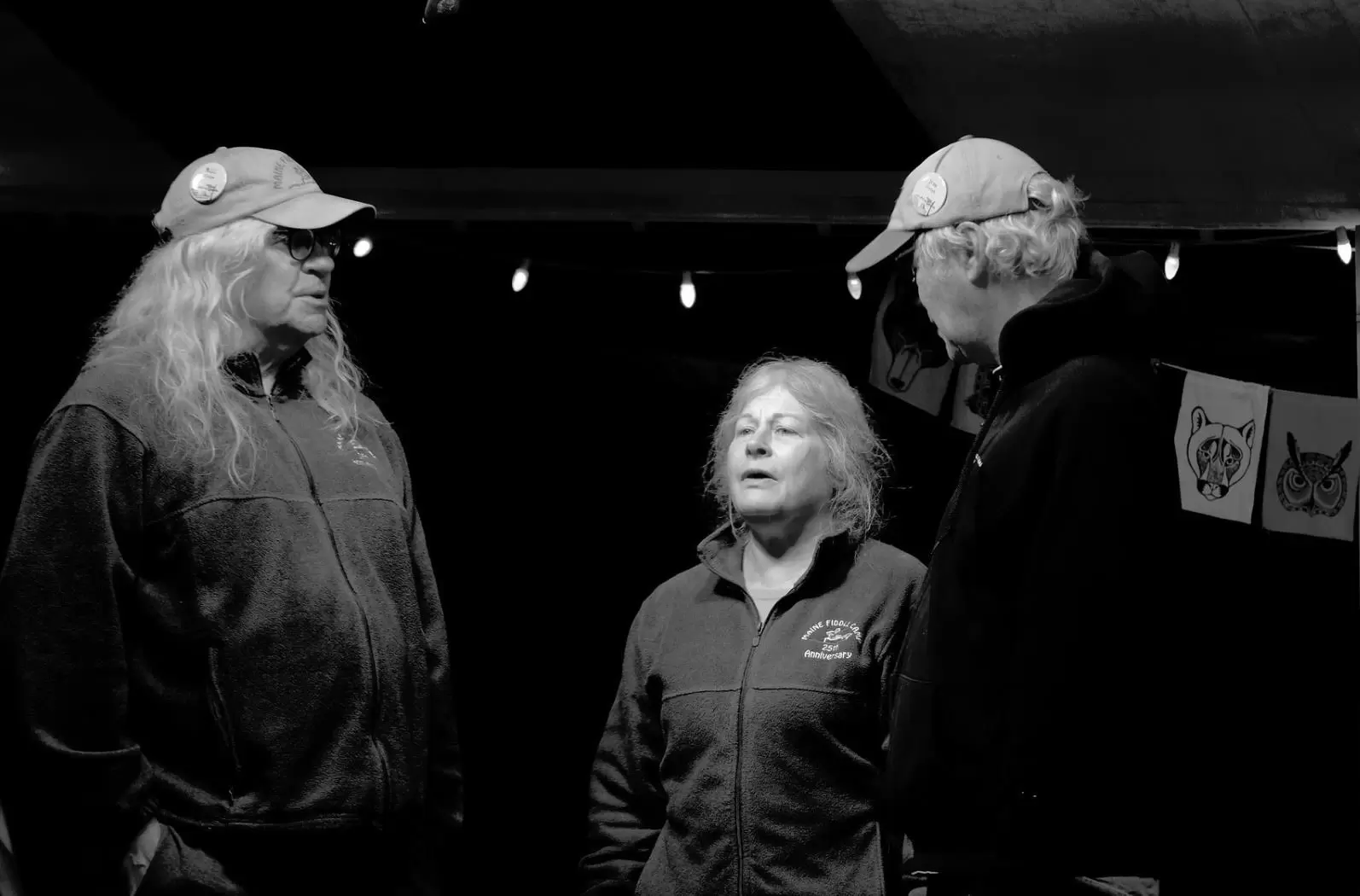
Bio adapted from Bill’s Website: I was born in Attleboro, MA, and grew up in Durham, NH. I played Tuba in the marching band all through school and learned Guitar from my scoutmaster. I went away to College in Pennsylvania in 1964, where I became exposed to Old Timey music. (It was the “Folk Revival” time!) I eventually started square and contradancing at the Tuesday night square dance at the International House at the University of PA. That was around 1977.
I moved to Maine in 1984 and started playing in a little band. We did some contradances and one day the caller didn’t show up…familiar story? A few years later (1992), I started playing with Scrod Pudding . We started playing around Maine and then New England and eventually did a recording and went on tour “down South” as far as the Carolinas and Tennessee.
This was an eye opening experience and we met many wonderful folks down there, dancers, organizers, musicians and we still keep in touch and head down that way as often as we can! T-Acadie (pronounced: “TEE ah-ka-DEE”) French for “a little Acadia”, was formed a few years later with Scrod members Pam Weeks and Jim Joseph in order to have a “compact” band that toured easily and also in response to some local requests for a “smaller” band to do various gigs. We play for contradances, but also do family and “community” type dances and concerts, where we all sing as well as play. In 2000, Pam and Jim formed the Cajun dance band, Jimmyjo and the Jumbol’ayuhs and I started to learn to appreciate Cajun and Zydeco music when I was asked to play guitar with the band.
Somewhere in the middle of all this, I started calling on my own in order to expand my horizons, and because there seemed to be a greater need for callers than for bands. I also started to compose my own dances . This was mainly to have dances available to call that “did what I wanted them to” (or maybe just ones I could REMEMBER!), but has grown to be away to commemorate a particular event, or honor a particular person. “Well THAT deserves a dance”., etc etc… Sometimes I spend years working on a particular dance, or more properly trying to get a particular combination of moves into the form of a pleasing dance. Sometimes a dance just hits me.
That’s the past, the present and a little look into the future. I hope to keep calling, playing, writing dances for many years to come. I love traveling around the country and experiencing the regional differences that exist in this art form we very loosely refer to as “contradancing”. I hope to keep meeting more dancers, musicians and callers in these places and learning new dances and tunes as well as making new friends.
Show Notes
Sound bites featured in this episode (in order of appearance):
- Bill calling his contra dance Weeks on the Road at the Ralph Page Dance Legacy Weekend in Durham, NH in 2020
- Bill calling the singing square dance On the Trail of the Lonesome Pine at the Ralph Page Dance Legacy Weekend in Durham, NH in 2020
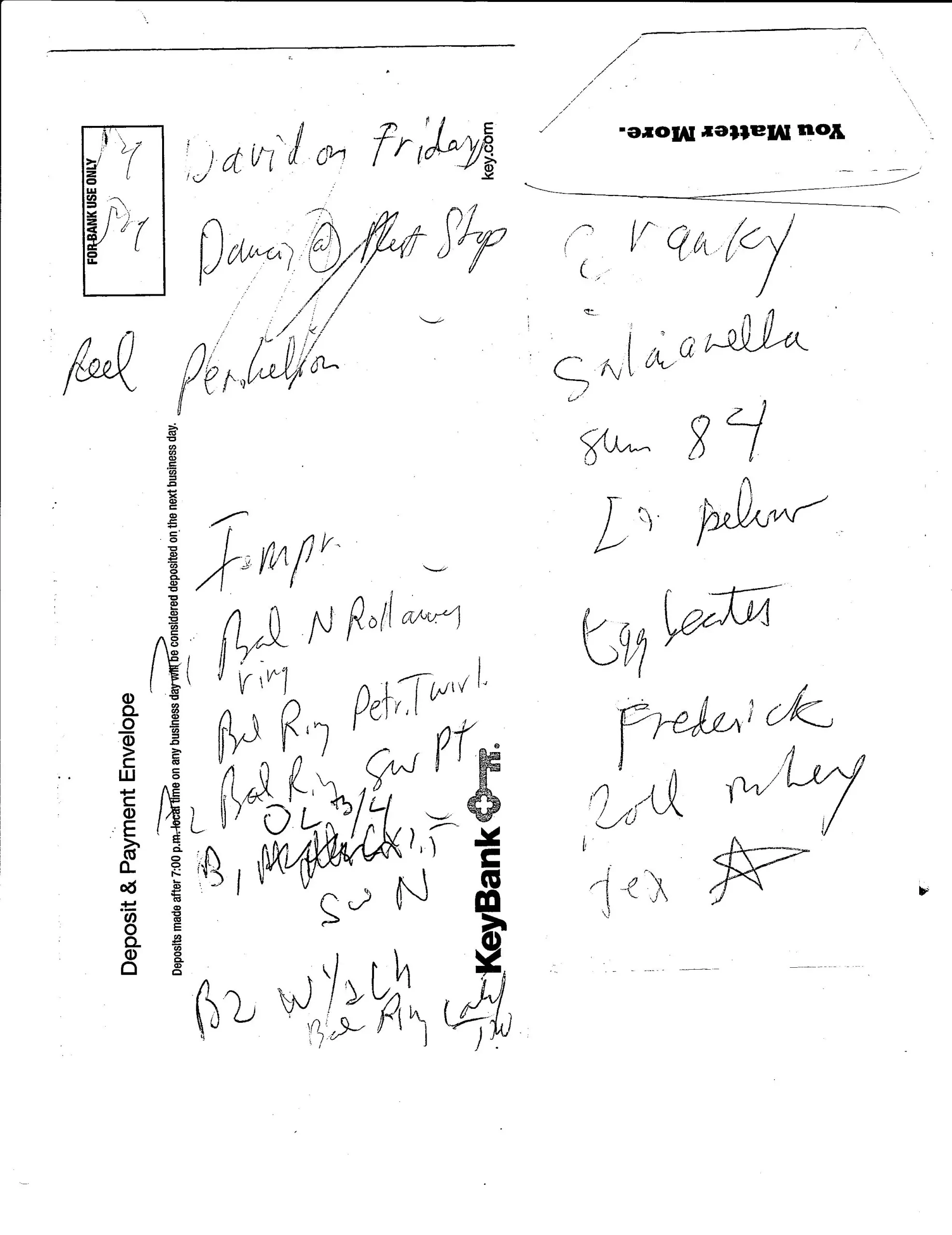
Dance Notation
Bill calls from memory!! From Bill:
I would often figure out my program (or at least some of the dances I wanted to call) while driving to the gig. If there was a dance I didn’t have committed to memory, I would figure it out and write it down (just in case). I found that bank “deposit envelopes” worked well for the stationery!
[click image to enlarge]
Episode Transcript
Click here to download a transcript
FTM Ep 33 – Bill Olson – Transcript
Mary: Welcome back to From the Mic. Today we have the pleasure of speaking with Bill Olson, a longtime fixture in the traditional music and dance community. Bill’s journey into this world began in college, when he first discovered the rich tapestry of bluegrass, old-time, and contra dancing. What started as a casual interest soon blossomed into a lifelong passion, as Bill immersed himself in the vibrant dance scene, eventually taking up the callers mic, among many other roles, to make music and dance happen.
Over the years, Bill has honed his craft, developing a unique style that prioritizes connection with the dancers. He’s a firm believer that the best callers know how to get out of their own way, setting aside the crutch of calling cards to truly engage with the crowd.
In our conversation, Bill shared insights into his evolution as a performer, the joys and challenges of reviving the singing square dance tradition, and how his self-described introverted nature has been transformed by his love for this community. It’s a fascinating look into the mind of someone who has dedicated himself to keeping these traditions alive in Maine, and everywhere.
So without further ado, let’s head downeast and hear more from Bill Olson.
Mary Wesley: Bill Olson, welcome to From the Mic!
Bill Olson: Well, it’s a pleasure to be Yeah. It’s been a while. Yep.
Mary Wesley: It has been a while. It is great to see you in your sort of home studio there that you have set up and excited to spend some time talking together. And hearing more of your story as a caller, a musician, a Mainer, a choreographer, many more things I’m sure I haven’t listed yet. We’ll get into that. Well, let’s jump into just a little bit of your biography, wherever you want to start us off to let us know how you found your way into this world of traditional music and dance.
Bill Olson: Okay. I found traditional music and dance. Well, traditional music was my was what led me into it. And I was in college and we had a folk festival. And the folk festival, my first, you know, freshman and sophomore year in college had, you know, Bill Monroe and Doc Watson at it and the New Lost City Ramblers. And I said, Oh my god, this is like something…like I never was familiar with, you know? Growing up I was in Boy Scouts and my scout master played the guitar and I picked up the guitar and singing around the campfire and in college everything changed and…
Mary Wesley: And where did where were you in college?
Bill Olson: Swarthmore in suburban Philadelphia. That turned me around and after after that I, you know, was going to bluegrass festivals and stuff, concerts and stuff. And that’s…it’s like and I hate to say it, it was like I was at this one concert and I think it maybe been the…I don’t know, the Highwood String Band or something like that. And I was sitting next to this young woman who, you know, I was very much attracted to, and she said, “Oh, you know, you ought to come to our contra dance!” This is like in the mid 70s. So this was in Philly. And I you know, I said, well, okay, I’m gonna, you know, follow the chick, you know? So…
Mary Wesley: The start of many great stories.
Bill Olson: Yeah, no, I’m sure it is. The dance, the local dance, it actually predated the Summit Church dance in Philly, but it led very soon into that. At any rate, it was the same band, same caller, and they basically called the same dances and played the same tunes every night. This was once a week. And that was great. I mean, this was so new and so unbelievably wonderful, and I never had any idea about calling at all. You know, it just…it was all about the dancing and the this young woman. The dance migrated to the Summit Church, and I remember like that’s when Ted Sannella’s Balance and Swing book came out. Okay, so it’s gotta be 1980 or something like that.
Mary Wesley: Yeah.
Bill Olson: And I remember they started a little workshop before the dance sometimes, you know, trying to get new callers in and I remember Jim Kitch up there with reading out of the Balance and Swing, you know, like fumbling around and I said, Yeah, I got no interest doing this at all. This is ridiculous, okay, I just want to dance. So we danced. I danced. Shortly after that, I found this square dance that was happening at the international center at the University of Pennsylvania every Wednesday night. I thought it was every Wednesday night. Some people say it was Thursday night, but that was what the Summit Church dance was, so I don’t know they couldn’t have been on top of each other.
Mary Wesley: Yeah.
Bill Olson: Anyway, and this was like old time music, and Bob Carlin played banjo and he kind of led the thing, and they started bringing in bands from away. And bottom line, I remember a caller from away, Sandy Bradley, a square dance caller from Washington state. And boy, she was such a personality on stage. I say, Wow, that’s really fun, you know. So that’s when, ,to me it got away from the caller being just some sort of appendage that, you know, facilitated the dance happening…to like actually having a personality up on the stage. That started to interest me. Okay. So shortly after that, moved to Maine and started playing in a little string band. And I’ve been dancing for several years. We had went down in Pennsylvania, we started to go to NEFFA and stuff like that, and then I sort of discovered, you know the Brattleboro Dawn dance, and I became like a dance gypsy… And started playing in a little string band, and we got a gig playing for like elderhostels. Just doing family dance stuff, barn dances, you know. And one day the woman in the band that normally did the calling didn’t show up on time and there were all these people here. Heard this story before, right?
Mary Wesley: Oh yeah.
Bill Olson: Well, you know, what are we gonna do? So I swear to God, and I wasn’t really all that accomplished a fiddler at that time, still am not, but there wasn’t anybody else there and people were ready to go. So I played the fiddle and called a dance at the same time that was the first time I ever called a contra dance in my life.
Mary Wesley: Now that’s not always the story! That you’re also fiddling.
Bill Olson: I know. And I said, yeah…right, and the rest is history, right? No. Moving on from there, I’m in Maine. Just started playing with this band and sort of got gigs calling little dances in the area and stuff, you know. Like I I remember one dance in Whitefield, it was basically a family dance. I had absolutely no idea what I was doing, and all I had was like some cards with simple, duple contra dances on it. And I’m fumbling my way through this with people that had never danced before. I didn’t even know what a whole set…a barn dance was. And in the front door comes Ted and Jean Sannella. And I said, holy smokes. Now what am I gonna do? Afterwards, and I’d just fumbled my way through the whole thing, afterwards, he came up and shook my hand and said I did a good job, which I knew I had not done a good job, but that’s the kind of guy he was. Sometime after that, there was the Down East Country Dance Festival. I got hooked up with my band, Scrod Pudding, where I was playing and calling at the same time. And I was always playing and sort of, you know, calling. And that’s a story that’s gonna come up later in this conversation, but like…trying to play…I was playing bass at the time and trying to read a card and play and interact with the band and all this stuff was difficult. Okay.
Mary Wesley: And remind us who are the other members of Scrod Pudding?
Bill Olson: Scrod Pudding. Okay. Pam Weeks, Jim Joseph on fiddle and mountain dulcimer, Jim Joseph on button accordion, banjo, foot percussion, Greg Anderson on hammered dulcimer and Eric Johnson on guitar, and I was playing bass. We actually…the band still is together. I mean, this is like 30-plus years later. How many bands last that long, right?
Mary Wesley: Yeah.
Bill Olson: And Pam and Jim and I are still doing gigs together as T-Acadie and the future is looking good for that. You know, we’re…now I’ve lost my train of thought.
Mary Wesley: Let’s see, yeah, I’ve jumped in to make sure we remember who Scrod Pudding is, but you were talking about when you just were getting started as Scrod Pudding and the Downeast Country Dance Festival.
Bill Olson: Yep. The dance festival…’91 kind of that was my first introduction to calling to a bigger audience. Around that same time, the North Whitefield 4th Friday contra dance started. This was after Ted Sannella, you know, this amazing Boston world renowned caller had retired and moved to Maine, and he lived very near to North Whitefield, where the dance was. And I guess it was sort of, well let’s start this dance because Ted’s here and so I became involved with that. I was doing sound for the dance, sitting in occasionally, and then I was behind the scenes watching this guy work, okay? And he was very fussy. He would give the band a piece of paper that had exactly what dances were gonna be on it, and the suggestions for the tunes, of course. He knew every band didn’t know every tune, so he would say, “or similar.” And we would pretty much always play the “or similar,” or the band would. But I’m just watching this guy work, and he like was a master. I mean he always had a card in front of him, I think maybe to the very end, though I know he didn’t need it, you know because a lot of times he would be turning around…you know like a couple of times through the dance he’d turn around and start looking for the next card for the next dance. And he’d have the microphone and he’d still be calling the dance, like you know… Like an absolute master of what was going on and just totally charming, warm, wonderful person. He would offer suggestions about stuff and everything like that. So one day I’m there calling, no doing sound for the dance. And I’ve probably been calling for a year or two or three and the same story from before happened again. The caller who…if you’re out there Susan I’m not saying anything bad about you! But it was Susan Kevra, and she had a car problem or something and couldn’t make it to the dance. And we didn’t have a caller. So they said, well, Bill, you could do it, right? And I said, well, I don’t have my cards or anything. Well, let’s see what we could do. And that was the beginning of this. I fumbled…I mean I I probably knew ten dances from memory and I called all ten of them. And I maybe even called one dance twice in the evening. There’s another story. Like you could do that and a lot of times the dancers never even notice, you know.
Mary Wesley: Yeah.
Bill Olson: They just want to dance. And you know, the same dance with a different set of tunes has a totally different feeling to it. Anyway, moving on. That got me sort of into this place of wow, you know, if you could just memorize the dance. I mean, how hard could it be? Like, these musicians, fiddlers and stuff, they know a hundred or two hundred or five hundred tunes. And a lot of them don’t need sheet music to read from. And a tune’s much more complicated than a dance that might have like eight different figures in it, you know. So I just said…that was the point where I saw, okay, I’m just gonna do this from now on. And I did. So for better or for worse, I stopped using cards to call. It made it a lot easier when I was playing and calling and interacting with the band, which I was doing. And so let’s say at the beginning it was Scrod Pudding at the third Saturday Bowdoinham dance in Maine. And then shortly after that, I don’t know exactly…through maybe the dance festival and stuff and just becoming more familiar with the…you know, kind of broader picture here of…you know, dance bands and callers and musicians and stuff. I met David Kaynor. And I could consider my mentors would be, you know, like maybe Sandy Bradley in a sort of a strange little way, Ted, and then Dave Kaynor, who, you know, played fiddle and called. And, you know, he didn’t need any cards. I said, well, you know, I’m just gonna do that. And he and I became great friends. And so there’s my start with calling and the mentorage. Okay, we could kind of put a semicolon right there and then you could ask me another question.
Mary Wesley: All right, that’s great. Well, yeah, I mean, I always do love hearing how people find and then develop their thing, you know, their style with calling. And so you have, you know, I’m noticing you have this integration with the music and the band, actually being in the band. And as Scrod Pudding, you would get hired as a package, is that right? So mostly caller/band, one one deal?
Bill Olson: For better or for worse, because as things developed, a lot of times people would assume that I only came with a band, and they didn’t need a band. So that worked, you know, against me sometimes.
Mary Wesley: ‘Cause you were also interested in being a free agent, to work with other bands?
Bill Olson: Yeah, I always was and you know, I mean it would happen, you know, here and there. But yeah…
Mary Wesley: I mean I am curious what you liked about that arrangement, when you were working with Scrod Pudding. What was the…”for the better?”
Bill Olson: Okay. So a lot of times when you’re working with a band that you’ve never met before, there’s this sort of scrambling around to know what tunes, you know, who you communicate with, who’s gonna give the four potatoes when you start the band, here’s the here’s the card, you know, where are the balances, what tune works best with that. Well, we could work out that stuff at practice like the week before, you know? So there was a lot of emphasis put on lining up a tune with the dance. And if you look at my website, rough as it is, a lot of the early dances on there specify tunes that we very much like…oh, not very much—exactly like Ted Sannella did, which we always had had such a problem with. “God, this guy’s so overbearing and telling us everything to do…”and then I’m finding there I am doing exactly the same thing, because it was a good idea, you know? But lining up tunes with dances was was one of the big, big benefits of being in the band and calling at the same time. But when you don’t have that option there’s often this like, surprise factor of calling, you know? Just say, well okay what do you got, we got to get started. Okay well just play this. Let’s just play this set of tunes and play…you don’t even know what the… And then it’s like, Wow that worked out really, really well! I never would have expected that set of jigs to work with that dance the way it did.” So there’s something to be said about just letting it free flow sometimes, because the dancers a lot of the time will figure out how to make it work.
Mary Wesley: Yeah, absolutely. You sound like you developed your caller approach—you know, you threw the cards away, you worked through material with Scrod Pudding. Did you feel like you were happy? I mean, the secret there with Scrod Pudding is you get to be both caller and musician. You don’t have to choose. Was that kind of deliberate? Did you want to stay equally being able to do both those things?
Bill Olson: Yeah, I guess I probably did. That was sort of the baseline. And Scrod Pudding finally kind of, you know…we played a couple of NEFFAs and got invited to do a Brattleboro Dawn Dance, and then we started going on tour and we would do the I-95 tour. And back in the day, you know, it was all done by telephone. You had to like, go get the CDSS paper, you know, monthly newsletter…into the back and read out who the contacts were for all the dances and then call people up on the phone and arrange these, you know. So we would do a tour up and down, maybe to Georgia or something, go through, you know, the North Carolina dances, the Virginia dances, Glen Echo, you know, whatever you could pick up in New England. Most of it was farther down south in the mid-Atlantic and the south. And it was always, you know, you would hire a caller and a band, which I think that probably made it easier on some of the organizers.
Mary Wesley: And how did you like touring and checking out all these other dances?
Bill Olson: Touring was great! But we had a five-piece band, and normally a dog too. So we’d have to figure out some way to fit everybody, you know? And normally bringing our own sound gear for a lot of gigs. So we were touring with five people, instruments, a dog, and sound gear! And we would try to do this all in one vehicle. So we’re like renting 15 person, you know, vans from Rent-A-Wreck and you know, building special things for the… You know, there’s an acoustic bass involved here too. So that would build a platform and that would go underneath, and there’d be some little place in the back where somebody could sleep, and you know, I mean that was what it was back in the day. But I mean, we had so much fun and we met so many wonderful people. It just…eventually it got old for a five piece band, and Pam and Jim and I started doing that as a trio, and maybe hiring a bass player for certain gigs down south. And we still always had the dog. We went on tour one time in a Honda Fit with three people, a dog, instruments and sound system in a Honda Fit.
Mary Wesley: Wow.
Bill Olson: Yep.
Mary Wesley: An achievement.
Bill Olson: Yep.
Mary Wesley: I have to ask, is the dog…I remember you being at dances with a border collie?
Bill Olson: Okay. That border collie was Sadie. She is passed on. There’s a new new dog that replaced Sadie. They overlapped a little bit. And he’s sort of another black dog. It’s really…okay, we’re really gonna go there? Okay, that’s because Pam will be happy.
Mary Wesley: I’m a dog, I gotta out myself, I’m a dog person. But I do specifically remember Sadie.
Bill Olson: Yeah. Sadie was a tour dog and she’s was on stage in I don’t know, we figured like 18 different states at dances. On stage, even in New York City. You know, they let us sneak her in. Nico came after that. He was part border collie, a little bit, and part flat coated retriever. He’s still alive, he’s like 10 now or something, nine or ten. And then the next the next dog in the in the series of dogs is another border collie. And her name is Sky. Another completely different personality. I mean, you know, do you have border collies?
Mary Wesley: No, I don’t. I’m a dogless dog lover, sadly. so that’s why I always ask about everyone else’s dog.
Bill Olson: Okay, okay. Well, okay. So Sky is like a purebred border collie, but unlike every other border collie in the world that I know of, she is totally attracted to water, just like a retriever. If there’s a puddle, she will jump into it and you know, I mean it’s just it’s like what the heck? Anyway, that’s the latest one.
Mary Wesley: Yeah.
Bill Olson: Yeah, I know. Yeah, well, they do this thing where they look, you know,it’s sort of like a…you know, like a collie, actually.
Mary Wesley: Okay. Yeah, they’re tending the flock.
Bill Olson: That’s yeah, no, that’s totally…anyway. Touring, it kind of got less and less until where it got just too hard to be in a car for that long and stuff like that. So we stopped doing it. And so you know, in fact, in a many ways just stopped, you know, playing for contra dances at all. I would do get a gig calling here and there and mostly sort of barn dance, you know, community dance kind of things. You know, got a Cajun dance band going, started playing for that. Can I talk about Cajun dances here?
Mary Wesley: Absolutely. Yeah.
Bill Olson: So the contra dance community as I came into it after the sort of folk revival and stuff, the contra dance community was always very sort of puritanical, okay, you know? It was always advertised as “chem free,” and I got no problem with that. Except that all of a sudden Pam and Jim were really into like Cajun music and they wanted me to join the band. And it’s sort of like everything’s gotta be “one, two, three, four, one, two, three, four,” you know, like orderly. And Cajun music is not like that. All the tunes are crooked…and so they finally nagged me into going down to premier Dewey Balfa, Cajun Creole Week, which was in Louisiana at a state park. And this was like in 2001. It was like the spring before 9/11. So we were still all innocent back then. Another story, but we won’t go there. And so I’m like…whole new world, okay. I’ve been playing with the Cajun band for a little bit, but I was still…like they said “Man, you gotta loosen up. You gotta loosen up,” okay? I didn’t understand.
I get down to Louisiana, get to this place, set up our tent, and we’re camping out. And here they got this big tent set up with a stage. And right next to it, they’ve got another tent set up, which was the beer tent, okay. And so then there’s people out there two-stepping and waltzing and stuff. And they’ve got a can of beer in their hand. I’m saying, wow, this is a completely different situation. And you know, like the musicians a lot of them needed like a half a bottle of whiskey, you know, before the dance, just to get them in the right place to be able to play. And I’m not aware of the music suffering at all from that, you know. It’s just part of the culture. So I think wow, there’s different cultures here in traditional music, and this is different for me. And I’m still adjusting to the fact that Cajun music is I mean, it’s like not New England contra dance tunes and stuff like that. And it’s wonderful. Many times I said, I just want to go do that. To heck with this calling thin., but then I say, well no, I don’t want to do that. I love calling. I love being up there on the stage. Because that’s a different thing. Having that connection, the caller and the dancers and…well and the band. That three way thing, yeah. So Cajun music…it’s like nothing else. It’s like nothing else.
[MUSIC BREAK]
Mary Wesley: Yeah, say more about the three way setup. I do often think about that a lot, obviously as a caller, ’cause it is different. You know, musicians connect with dancers profoundly, but the but callers, you got something else going on there.
Bill Olson: Yeah. You know in some ways it’s a three-way thing. There’s three connections. There’s the connection between the caller and the dancers. There’s a connection between the caller and the band, and there’s obviously the connection between the band and the dancers. And a lot of the work of the caller, that connection that happens between the caller and the dancers, happens, basically in the walkthrough and the first time through and the and your job is to give yourself not a job. It’s like…so if you’ve done your job well, you can drop out after one time. I mean, there’s another whole thing right there we can talk about, but right now you basically…your job is to get out as quickly as you can and let the dancers connect with the music, because that’s what makes the whole thing work. I mean, the whole intent is to have your body move in time with the beat of the music. And the caller, you know, you’re up there to hopefully you know, make sure things are going well and hopefully you don’t have anything to do at all. But if there’s a problem anywhere in the dance, then you can fix that without causing too much disruption. So that’s what I think, you know, your job—there’s three different connections. They don’t all happen necessarily at the same time.
Mary Wesley: Simultaneously. Yeah, that’s great.
Bill Olson: But with squares it’s a different story. You’re pretty much, you’re on the whole time through.
Mary Wesley: And do you call squares too? Is that in the mix?
Bill Olson: Oh yeah. You know, being a musician and a singer
Mary Wesley: Right.
Bill Olson: I think wow god…
Mary Wesley: And Sandy Bradley, of course.
Bill Olson: Well, yeah, singing squares is like kind of a no brainer. And I’ve really been concentrating on that lately. And you know, it always was in New England. Well, even in, let’s just say in the Northeast where you know, primer primarily I’ve been calling. It was like, yeah, if you you say, Well, the next we’re gonna call squares. And half the people would sit down. I mean, that’s my experience. And you say, Well, okay, I can eliminate that problem just by not calling any squares. And, well like what fun is that? Because squares are really fun, you know. And so, I’m gonna say…I remember was it at God, I can’t remember where it was. You were calling a set of singing squares and you just started out with Nelly Bly.
Mary Wesley: Might have been a NEFFA.
Bill Olson: Was that NEFFA?
Mary Wesley: It’s kind of shocking to me because I haven’t called tons of singing squares in a long time. But I definitely, I do remember…so it’s shocking to look back and think, wow, I like pitched a whole session of singing squares!? I’m trying to remember if it was just me or if it was like a showcase.
Bill Olson: It was just you.
Mary Wesley: It was just me.
Bill Olson: Well it’s only 50 minutes. Yeah, you had enough material.
Mary Wesley: You know, it was probably on the tails of taking…I got to take the class that Nils Fredland and Ralph Sweet taught together.
Bill Olson: Yeah, well I knew…like a lot of the stuff that you were calling was kind of out of Ralph’s book. This is after Nils, you know, and Ralph collaborated on the book and so…anyway.
Mary Wesley: Yeah, this is good. I should dust those off.
Bill Olson: You should dust them off.
Mary Wesley: Yeah.
Bill Olson: So it’s like, squares…recently’s another diversion, but recently Chris Ricciotti moved to Maine. He lives in Montville where Maine fiddle camp is. And he started up a a dance there and it’s primarily squares. In fact, we played for it one time and it was all squares. And he just decided he’s gonna bring that back somehow, you know? Who was the caller duo with Susan Taylor and…
Mary Wesley: Janine Smith.
Bill Olson: Janine.
Mary Wesley: Oh yeah.
Bill Olson: That’s Two something…Chicks?
Mary Wesley: I don’t remember what they were calling themselves.
Bill Olson: Two hot chicks or something like that. They call themselves something like that. They started a square dance in suburban Washington DC. This was a thing where when they started it out, they said, well, we’re gonna call it at this church where there’s no parking. And it’s in the big city, it’s public transportation only, and it’s square dances only. We don’t know if anybody at all is gonna show up for this dance. And like 250 or 300 people showed up for the first dance. I mean, it’s like squares are not dead. And I…just to bring this thing quickly right around to the to the beginning again, I want to be a part of that, you know, of squares not being dead. So yes, I’m working on singing squares, and that’s part of what I try to do every time I call a dance is call at least one singing square. Anyway, we’ll get back, we’ll get there. So that’s part of my mission.
Mary Wesley: I love it.
Bill Olson: Yeah.
Mary Wesley: Well, yeah, I do want to get caught up to present day, but let’s stay a little longer just in the abstract, philosophical, you know… So you’re kind of talking about this idea of, part of the caller’s job is to kind of get out of the way. And I wonder if getting rid of cards, aside from maybe having one less thing to do while you’re also trying to be in the band, is any of that connected to like, how you feel tuned in with the dancers? Do you also want the card out of the way, but so you can kind of do your thing?
Bill Olson: I mean some of the callers, and I’m not gonna mention names, but some of the callers that I really admire have a book or a laptop or something. They got it on that…but they’re not sitting there with it in front of…and I think if you do sit there with the card or the laptop computer or iPad in front of your face, you’re not connecting with the dancers. You can’t possibly connect with the dancers. So I feel like, yeah, throwing away the cards definitely connected me more to the dancers. I know other people…the few other people that I know that do that, Dave Kaynor for one, that was certainly the case with him. Yeah and so yeah.
Mary Wesley: So then what else is in your toolbox? And what are things that you have in mind when you’re trying to work with a group of people and just give them a really great time as a caller?
Bill Olson: I think, just to follow along on what we just said, like being kind of available to kind of fix things if they get mixed up is kind of like a good thing. I know there’s a line of thought that if you teach the dance, you call it the first time through, and then you get out and you don’t ever get back in again because the dancers are gonna fix it. If there’s a problem, they’re gonna fix it by themselves, which is often the case. It’s not always the case. Sometimes I see people drop out of the dance, and I think that’s the worst thing that could possibly happen. So if the caller has to jump in and sort of…I mean, a lot of times the dance…and this could have to do with picking the wrong dance for the crowd, or possibly the band playing a tempo that’s like too fast for…a lot of times people get so far behind that for me, the dance just loses, you know, like that whole connection. You know, it’s like sort of balance and swing at the top of the first B part, let’s say, and everybody’s still…they just started swinging the swing that happens before that or something. And that’s sort of…that really annoys me and it makes me want to step in and and fix that. That’s a slippery slope. You know, you could be spending your whole time trying to fix something that maybe is gonna fix itself. You know, there’s a balance there and I I don’t know where it is. I’m still learning about that. But nonetheless, I mean, you gotta be aware of what’s going on there, first of all. Anyway, you know..
Mary Wesley: Right, gotta be watching ’em like a border collie.
Bill Olson: Yep, exactly. Yep.
Mary Wesley: How about in the walkthrough and kind of, the part of the caller’s job that is kind of a host and teacher.
Bill Olson: Yeah. Well I’m gonna start off with…you wanna go back to a beginner’s beginner’s session?
Mary Wesley: Sure. Yeah.
Bill Olson: I mean, if you’re calling a dance that has all really experienced dancers, you don’t need a lesson at all. I don’t get very much of that anymore. What I’ll have is a dance with half the people are experienced dancers that just want to come and, you know, help out or have fun, even if it’s just barn dances, and half of the people have never done this before, ever. So I mean I’ve seen beginners sessions…like I’ve been horrified at beginner sessions where the caller or maybe not even the caller, the dance organizers have a group of people that sit there and teach 23 different contra dance figures to people who have never danced before. And expecting somehow that’s gonna make a difference in the dance, like they’re gonna remember that when they… And so when I do a beginner session, and it’s admittedly it’s for these mixed groups, it always starts out with: “Okay, I’m the caller, my name’s Bill. I tell you what to do and you do it. If I tell you to do this and you do this, and then I tell you to do that, stop doing this and start doing that, you know? And just basic stuff. And I swear to God, I got most of this originally from George Marshall beginner lessons. So, you know, I didn’t invent it. But just get in a circle, everybody circle left bop, bop, bop, bop, and back to the right… But just getting the dancers to understand that you’re prompting them.
That, you know, along with the beat and the timing of the music, you’re telling them what to do ahead of time, and then you do that. I mean, just getting that understanding into dancers who have never done this before is like, half the battle. And then you say, you don’t have to remember all this stuff, everything gets taught ahead of time, and we’ll move this up a little bit at a time. And so, you know, I mean, people don’t have a problem with it. And if half the crowd is experienced dancers, if you don’t get those little clusters of four people that never did it, it normally does fix itself. And I think the most important thing about the walkthrough is not only telling people what to do and keeping an eye on the crowd watching them. [It’s also] being aware of whether they understand the language, what you’re saying, and then modifying that if they don’t. And then not only that, but telling them where you’re supposed to end up after you do what you were told to do. For me, I mean it’s all about flow, I guess is the word. If you tell a dancer to do this, chances are, for a dance that’s not too quirky, they’re gonna have the hand available to do the next thing without really almost having to be told what to do. As long as you teach it the right way. So being aware of that, being aware of the flow and you know, you could spend a lot of time telling people how to end up after a swing.
Mary Wesley: Yeah.
Bill Olson: I mean I trip over this all the time. It’s easier for me to say: ladies on the right, gents on the left, or right hand person on the right, left hand person on the left, that’ll work okay. Larks and robins, I kinda get confused with birds somehow.
Mary Wesley: Got the alliteration there at least. Larks, left Robins, right.
Bill Olson: Right. No, no, no. That makes perfect sense. And this is another whole subject that maybe we’ll get into, or maybe we’ll not. But basically, if somewhere in the beginner session and the walkthrough that you can impress upon people that you’re ending up with the right hand person on the right and the left hand person on the left, man, you’ve got a lot of the problems solved right there, you know. And then I also say, you know, if you’re in the dance and all of a sudden you don’t know what you’re doing, and somebody comes up to you in the dance and they look like they do know what they’re doing, go with that! And you know, most of the time that’s good advice. Sometimes it’s not, but you know.
Mary Wesley: Yeah.
Bill Olson: Yeah. All right.
Mary Wesley: Nice. And so you also write a lot of dances or have written a lot of dances. When did that come into the mix?
Bill Olson: It seemed like…I don’t know why I wrote my first dance. Some of the first dances that I wrote were horrible, you know, and one of them even got published in the CDSS journal. Dan Pearl put it in there, and it was called Bowdoinham Reel and it had a swing into a circle right or something like that. It was totally against any natural flow there would ever be. And it was sort of embarrassing that that’s still out there. I think I started writing dances because…there’s two things. One you might say was just selfish. It was sort of like, well, that’d be easier for me to remember if I’m sitting there trying to call a dance without a card. But also, I saw there’s a place where the certain flow wasn’t working right for me. And so I wanted to fix that. And you know, of course, some of the like a lot of callers started out their first dances…choreographers, the first dances they wrote were fixing other dances. Or taking a dance that already existed and making a mirror image of it and then you know, calling it something else and stuff like that. And I always wanted to find…and I’m an engineer by training. So I have this sort of like, you know, engineer’s mind. I want to make things fit together and find a way that you didn’t originally think would be there, you know? Sort of like a right-hand star into a right and left through, you know? Your right hands are all in there and all of a sudden, you know, with just a tiny little change, you can pull by.
Mary Wesley: Mm-hmm.
Bill Olson: It’s all about the hook. Okay. You don’t want to write a new dance that has 12 new things in it. What you want to do is write a dance that you’ve said…you get the hook and then you build something around that. You don’t just keep piling more and more stuff. It’s all about having the dance be elegant, too, you know? It’s sort of like, it doesn’t have to be complicated. I’ve seen dances that are new, obviously new and have new figures in them, or new combinations of figures, that are what I consider to be really clunky, you know? Like, yeah, okay, you can do that, and maybe a group of really good dancers can make this thing flow well, but maybe not. And why make it that complicated? Come up with something that you think would, you know…it’s like, wow,I never did that before. And do that and build it around that rather than… So, flow and the hook. There’s my two things about choreography.
Mary Wesley: They’re great. They’re great. I mean, Cranky Ingenuity is just…I would say in the, you know the modern canon. And there’s many more besides that.
Bill Olson: Okay, thank you. Thank you. Thank you.
Mary Wesley: It’s also one of the great dance names for me. I love that name.
Bill Olson: So I worked for several years with Yankee Ingenuity calling at the Monday, was that Monday night, the Scout House dance and Mary Lea and Jack O’Connor and and ***** Barnes, Kate and Hal. And you know, I mean the name says everything. Anybody that ever worked with them, you know? It was like the dance, you know, it was stolen from a lot of different places, but the name came up naturally.
Mary Wesley: I love it.
Bill Olson: Yeah, me too.
Mary Wesley: And some of your circle dances too. I I have a couple of yours in my box. And I love that…you’ve written some dances that those are ones I can pull out and people say, “Hey, I liked that circle dance,” which is always my sort of secret mission. I’m like, hey, you can write a circle mixer with flow, you know?
Bill Olson: Yeah. Oh yeah. No. Yeah. Cool. Wow, wow. Yeah. Making me feel good now.
Mary Wesley: Good. As you should.
[MUSIC BREAK]
Mary Wesley: Let’s move into the present day, which can be both, you know, what are you up to lately? And then also our classic, you know, what’s changed? What’s different?
Bill Olson: Okay, yeah.
Mary Wesley: A long view, and how’s that going.
Bill Olson: What am I up to lately? Let’s go into this thing…where the a couple of things. There was contributing factors, okay? And this this is gonna gonna bring up sort of controversial sort of issues. So be aware, be you know, be aware everybody.
Mary Wesley: Fair warning.
Bill Olson: Yeah, warning.
Mary Wesley: But we’re gonna have time to talk about it, which is what I like to have on this show.
Bill Olson: Okay. So for a short period of time I was sort of on the calling…you know for weekends and stuff, nationally and stuff like that. And that’s really fun. I really love doing it and I got to meet lots of wonderful people doing that and stuff like that. But then, it’s like a lot of the dance organization got passed on to younger people and a lot of them wanted to hire you know, the young hot bands and callers and stuff, and they were hiring their peers and you know, that’s all just fine. I felt a little bit left out of all that, though I realized that as a caller, I was always a little much of an acquired taste, okay. COVID happened, a lot of things happen. Maine Fiddle Camp happened. The dances that are done every night at Maine Fiddle Camp…we called it an old old time country barn dance. And they are whole-set, longways dances. And Dudley Laufman, great friend of mine, comes every, you know…even now at 92, 93, or however the hell old he is now…every, every session to Maine Fiddle Camp and you know, teaches the band the all the old tunes that he wants and calls these dances… Back in the day, and we’re talking 30 years ago or so, I would go to a Dudley dance thinking it was, you know, something I might like and I went…Oh man, this guy’s so crotchety and so demanding and you know, he doesn’t hesitate to speak his mind right into the microphone and, you know and sort of insult people and stuff. I mean a lot of the old guys are that way. Ralph Page was that way, even worse you know I think Dud kind of got some of his shtick from Ralph and I’m going, oh man, you know… Back then I was like, this is really horrible.
And then I’m like…things evolve and I’m not getting asked to do weekends anymore and I’m getting asked to do, you know, family dances, local family dances, and realizing how fun they are. It’s just people that have never done this before, hearing music that maybe they’ve never even heard this kind of music before, and getting to move their bodies you know, in time with the music and stuff blah blah blah… I’m going: holy shit I’ve become Dudley, you know? But you know, that’s not such a bad thing. I mean, it bypasses this whole ladies and gents thing almost totally. And so I find that I’ve moved…for a while I moved away from wanting to do duple contras at contra dances, you know, the modern urban contra dance scene, and into doing this sort of thing. And I really, really loved it. And then I say, God, like I but I miss the other thing. I miss that sort of complexity of being able to guide people through something that’s like more difficult than doing this blah blah blah… And then going down to the end of the set and starting everything over again. I mean we need that. So here I am now, COVID shut everything down, and some of the dances are still just getting going again. And I mean, I know the the Thursday night Portland, Maine dance is just starting up soon. And then all of a sudden I’m getting to asked to dance call contra dances again, you know.
So well, okay…so things have changed. It’s like, now I’m not gonna call ladies and gents anymore. I’m gonna call larks and robins. Okay, well how hard can that be? It’s not hard. It’s trivial. It’s absolutely trivial, but there are some callers that say, I can’t do that. I can’t do that. Here…and this is like a maybe a country/city thing or a Maine…we’re getting into the regional thing now. I say okay, well we’re gonna do larks and robins. Okay. Well, as you stand with your partner facing your neighbors, the lark’s on the left and the robin’s on the right. That’s all you need to know. And so the dance starts and I look out there and 99.9 percent of the dancers have the gent on the left and the lady on the right. I mean seriously it’s like it nothing ever changed. So why am I doing this? Well I’m doing this because there are people, and I understand I’m sympathetic, there are people that are offended. And there are people who are left out if you don’t do it. And here it’s a very, very small group of people, almost non-existent sometimes. Because even the people who do want to dance what would traditionally be the other role, don’t care. Say it’s a role, and I’m gonna I’m gonna say “lady” and “gent” and don’t take it take it too personally. Everybody just rolls with that. And then there are places I’m aware of and I’ve been to where that’s…they’re not gonna roll with that. So that changed.
But I’m just totally happy with just saying, okay, you’re a lark, and you’re a robin, and you know, one dance…maybe a really busy dance might have two instances where you have to remember who’s the lark and who’s the robin. And several dances don’t have anyit’…s just neighbor and partner, you know? It’s not a big deal. That changed. So over that period of time when we were all shut down my main band, T-Acadie, which is Pam Weeks and Jim Joseph and I, we never stopped. We practiced twice a week. We were our own little bubble and we weren’t afraid of getting sick from each other and we just kept playing and practicing, and we and we were doing online stuff. We were doing some outside stuff that we figured people wouldn’t get sick in. But we’re doing a lot of concerts and stuff and it sort of moved into this place of like, Wow, I really like playing and singing, you know. And I like playing in a concert setting and stuff. So that started to move, you know…wow, that’s a different thing. But it’s very, very satisfying. And it’s maybe…it’s sort of like, there’s just, you know, we talk about that triangle of the the three connections between the caller and the band. There’s only one connection. It’s between you, the musician, and the audience. And that’s kind of a special thing that’s you know, there’s only two directions. The audience feeds you and you feed the audience, rather than the other four different things that are are going on there.
So that happened, and I’m still getting gigs, doing concerts and stuff. And then that’s just, you know, I mean T-Acadie we do, you know, Quebecois and old time and New England and old English…and 1950s do wop. And you know it’s like…it’s totally, totally, fun. And then there’s the whole Cajun scene. And we were doing a lot of, you know, festivals and stuff. You know, as kind of a New England band that did Cajun music, sort of like a… And that’s kind of happening less and less, a lot of them. I don’t know, the budgets got shrunk down for some of these weekends and stuff. But there’s still this, like, Maine Cajun/Zydeco dance weekend in Cherryfield, Maine every July. And we’re still part of that, and I never don’t get amazed by it. So that’s going on at the same time. And then you know, I’ve been starting to call contra dances again. You know, it’s like we’re coming back around. And you know, believe me, we all know…things swing one way and they swing back the other way. And you know, here we are swinging back the other way, I guess.
Mary Wesley: Yeah, yeah. Just gotta be on the ride. I should have asked this at the beginning, but did you grow up in Maine?
Bill Olson: No, I was born in Attleboro, Massachusetts. Okay. My dad was from Providence. My mom was from Chicago. They met during World War II. And when I was born they lived in, believe it or not, Mansfield, Massachusetts.
Mary Wesley: Okay.
Bill Olson: Yeah, right. So I said like, going to NEFFA those couple of years was like going home. But the place where we lived then no longer existed. But my dad was a coach, basketball coach. So we moved around a lot as he pursued his career. We went to Illinois and we came back to New Hampshire. And I kind of think of where I grew up, which was sort of like fifth grade through high school, was Durham, New Hampshire. So I think of that as being home and UNH, you know. So the Ralph Page Legacy Weekend, like in the Memorial Union Building there. We used to go and you know, shoot pool down in the basement and play candlestick bowling. And then later on it was like, oh God, we’re dancing upstairs in that big room upstairs. I knew it very well. So I am a New Englander, but I’m not a Mainer. The reason I moved to Maine was after college, which was in Pennsylvania, I wanted to move back to New England and there wasn’t anybody left in New Hampshire. My brother Bruce was in Maine, so I said, Well, I’ll go go up there somewhere near him, so that’s what I did.
Mary Wesley: Yeah. And has living in Maine been an influence on you as a caller, musician, dancer? I mean, it’s got a scene for sure. I mean, Maine Fiddle Camp…you know, lots of dances. Ten Sannella’s an influence, you know. I just wonder how much of that you kind of associate with Maine, or is it just happenstance?
Bill Olson: Well, you know, when I first moved here, there were still some of the old time dances still happening, okay. There was the Blue Goose dance hall, which is like…maybe that was like Northport, it was like Belfast basically. It was an old dance hall and there was one in Greene, Maine, an old grange dance that…this was a holdover from the early 20th century. And there was a dance up near Bethel and some of these old dances had been going on for a hundred years. And they had the local orchestra that had, you know, maybe a fiddle in it, but maybe a trombone and a piano and you know there was one in West Paris, Maine, okay. And Pam, when she first moved to Maine actually got to play in that dance a few times because they…just anybody…it was a you know, everybody come, local musicians. And then they would play Lady of the Lake and you know, they would do some of the old chestnuts and, I don’t know a schottishe and a waltz and…and so that was still going on when I first moved here. And then there was the infamous Bowdoinham first Saturday country dance with the Maine Country Dance Orchestra, which was organized by Doug Protsik and Greg Boardman and Carter Newell and Smokey McKean…the Old Gray Goose Gang. What they were trying to emulate was a Dudley Laufmann dance, because they met him somewhere along the way. So instead of the Canterbury Country Dance Orchestra it was the Maine country dance orchestra.
And so they would have this dance, they started this dance in Bowdoinham on the first Saturday and it was a band run dance. The calling was…members of the band would call the dance and a lot of times they would walk through the dance and it didn’t even work. You didn’t end up at the beginning…at the end…but they said, what the heck you know, figure it out for yourselves. And it was that loose. But I even started coming…I came to that dance a couple of times even before I moved to Maine, when I was still in Pennsylvania. Because I heard about this dance in the backwoods of Maine where the you know locals came in and they, you know they parked their ax and a log outside the door and went in. And then there were a lot of like little local dances, basically with, you know, the same band. There are a couple little local bands. And it was you know sort of this folk revival scene of dancing. But the old time dance was still there, you know. I don’t think any of them are anymore except maybe the Monson dance at the Finnish Farmers Club. You could argue that that has been going on, you know, ever since a long time time ago.
So Maine is interesting because I mean, I always tell people you know ,Maine’s the only state in the contiguous 48 states that’s only bordered by one other state. Think about it. And it’s New Hampshire, right? And all the other borders are Canada, Quebec, New Brunswick, and if you look over the, you know, Atlantic Ocean, you know, you could say Nova Scotia too. And so a lot of the traditional musical influence comes from Canada.
Mary Wesley: Right.
Bill Olson: And there’s sort of the downeast, you know, we talk about downeast Maine, you know, meaning down wind. But downeast music normally meant sort of, Canadian maritime music. Like Don Messer and stuff like that. All that stuff had a influence on the fiddlers that were playing in the logging camps and stuff like that. Then there was sort of Scottish and Irish kind of emigration to Maine, and there were little enclaves of Scottish music. And then there was the Scandinavians too. I mean there are towns like New Sweden and Norway and stuff like that. So there’s…it’s a mishmash of music, I would say as far as the dance scene goes. Mostly Canadian and Celtic, you know. And of course those two are related, too.
Mary Wesley: Yeah.
Bill Olson: And then there was like, there’s an old timer—Don Roy is a traditional fiddler. He started the fiddle orchestra Fiddlelicious, which does a series of concerts every October. But that’s a fiddle orchestra of like, over a hundred people. He learned to play fiddle from his uncle, Lucian Matthew, and would go to all these fiddle contests and stuff all over New England and Canada. And so I mean, back in the day, you know, you just drove across the border and you know, played in a fiddle contest in Nova Scotia or something. And Lucian became a really good friend of all of ours and stuff like that. But he was like a bluegrass fiddler for a long time, and then he would, you know, play all these downeast tunes and stuff like that. So the traditional music scene is kind of a mixed up hybrid, you know. The dancing, I would say back in the day, it was I don’t remember that many, you know, French Canadian quadrilles being part of the programs. It was contra, but it was always contras and polkas and scottisches and waltzes kind of mixed up into this sort of scene, you know? So that’s what I landed in here when I moved to Maine and it was, you know…it’s sort of…a lot of tunes they played were southern old time tunes. I mean, you know, the music crossed over all the boundaries, you know.
Mary Wesley: Yes, as it does.
Bill Olson: As it does. Yeah, thank God.
Mary Wesley: Well I might start steering us to wrap up soon, but anything feel like…major that we missed? I feel like we covered a lot.
Bill Olson: Yeah, you had talked about changes in the tradition over time and we touched about that in some ways and stuff. I would say that truly…the basis of the dance really hasn’t changed that much. I mean there’s like all these changing the words and the calling. And there’s this sort of city versus country thing. I played played a dance last night in Portland, Maine, you know, being the big city. And that’s yeah, big city. And you know, I’ve mostly been playing farther out than that, farther north and east. And I noticed a definite difference. Like, the tradition has changed. I mean, for one thing, they ran the dances so short that we didn’t…the band said, well God, why are we doing three tune sets? We should be doing two tune sets because there’s not even any time to to develop the the tune. Which is you know, if you’re a band you kinda wanna give your best thing. And you know, you’d just change into the third tune and have the caller say, “one more time,” you know. But the basic…the basis of the dance really hasn’t changed at all, you know. It’s still there’s that, you know, three way thing between the caller and the dancers and the band. And the music’s the same and you know, the people that have trouble with that part of it, just you know, I say just get over it, you know? I mean seriously…
Mary Wesley: Keep dancing.
Bill Olson: Yeah, keep dancing. And you know, the people have dropped out because you know, of the gender neutral kind of way it is, it’s kind of…you know…gee.
Mary Wesley: It’s a folk tradition. It’s dynamic and evolving.
Bill Olson: Evolving. Yep.
Mary Wesley: Good stuff.
Bill Olson: Yeah.
Mary Wesley: Well, I have three questions I usually close with just for a little end cap.
Bill Olson: Shoot! Yep.
Mary Wesley: And one, I I’ll be curious to hear…I often want to hear…as callers, you know, how people keep their dance collections. How do you keep notation of choreography, you know? And so you don’t have cards with you on stage, but do you have, you know, a notation system? Do you have things you refer to? Or is it just purely…have you drilled them into your head? How do you remember your dances?
Bill Olson: Yeah, okay. So if I’m gonna put a program together for a dance, I get an old back of an old envelope and I write down a bunch of dances from my memory that I think I would like to call. This limits me somewhat. I used to have probably a hundred dances that I could recall. Sometimes I would need to…like once I decided I wanted to call that dance, then I would need to like, refresh my mind. Sometimes actually look it up. And I could look it up by going on online. You know, that’s a nice resource now. I don’t have cards, I don’t use cards, I don’t go to the Caller’s Box and look up stuff. And I do, when I go to a dance, I remember dances that are new ones, and I still have a pretty good memory. So I can remember stuff and write it down after I get home. So it’s all done by memory.
I brought this up a couple of times on some of the callers’ email lists and stuff, and it’s like I bring up that and it’s like, I get absolutely no response at all. It’s like I’m talking some sort of foreign language when I say that because people apparently do not do that, although I know any one of them, or you know, you or me or any could put together…if you were pressed, you could put together a dance program without ever consulting any written down thing at all. I mean you just would have to think about it for a while and then you could do it. So that’s my archive and I’m always, you know, looking for new dances and sometimes I’ll just be looking, you know, looking at YouTube videos and stuff and see something. I mean, it’s just like…whatever’s happening, you know, is it something new. So yeah, it’s all in my ever fading brain, you know.
Mary Wesley: Your file box in your mind.
Bill Olson: Yeah, the old file box right there.
Mary Wesley: I love it. Well, it’s a good challenge to all of us callers.
Bill Olson: It’s really, really good.
Mary Wesley: Try a program from memories.
Bill Olson: Or just a couple dances, you know. And you know, it’s like, it helps you understand how everything flows together better, you know? It’s like if you always have to read the music to play a tune, you never actually listen to yourself playing the tune, you know? Anyway, I make that correlation, but…some people don’t understand that. Anyway…
Mary Wesley: I love it. Second, is there anything that you do, pre gig or post gig? Anyways you kind of…rituals? Anything you like to do before you step on stage or or after when you’re all done?
Bill Olson: Okay. Yeah. I mean, first of all, a lot of times all you do is just wing it. You show up on the stage, it’s the first time you’ve ever seen the band and all you can do is say, okay, who do I talk to about who’s starting the tune? Who do I talk to about what kind of tune to play for, you know, a particular dance? And if, you know, I don’t know, show somebody a card…I mean, I can’t show them a card, but I can outline what…you know, needs to have balances in the A part. Find out who’s in charge of the of the band, of calling the shots with the band. Find out if they play two tune sets or three tune sets. If I have time, if there is time ahead of time, I like to get like a tune list so I can say, well, you know, choose from that. But that’s, you know, truthfully, rarely, rarely the situation. I mean, you try to do it and you end up just winging it anyway. So I would say for me, if I was doing a big time weekend thing or you know, festival or something, I would spend more time ahead of time, you know, talking to the band and stuff like that.
Mary Wesley: Right, ok, not a set thing. What about when it’s all over? Do you…are you revved up? Do you wanna chat and hang out or are you ready to have a quiet moment?
Bill Olson: Oh I’m totally, I totally like to chat and hang out, and say, oh, you know, I really love from both directions. So say like, as a member of the band talking to a caller to go over and say: this worked really, really well. You know, remember for my point about you know, write it down or remember it! You know, from the other point of view, write it down or remember it, you know. You know, a lot of what happens afterwards is sort of going over the whole thing and trying to reconstruct what went well and what didn’t, and then trying to figure out, you know…do the do the went-wells more and do the didn’t-work-outs less. Yep.
Mary Wesley:Yes, we can always learn.
Bill Olson: Yep. And that’s what’s so much fun about this. You know, it’s like you’re always learning. Yep.
Mary Wesley: Yeah. I love it. Well, my last question is sort of a reader’s digest survey question, but I have been asking everyone if they feel more like an introvert or an extrovert, or somewhere in between. Just merely for the, you know, the interpersonal component of being a…
Bill Olson: Well I…yeah. I understand that because I feel like a lot of people, a lot of musicians are basically introverts, you know? They like to sit in the little corner somewhere and play, you know, play the fiddle or something like that. Callers are kind of…by definition have to be extroverts, you know. I mean you have to like…you know…But I think there’s a lot of trying to…what do we say, you know…fake it?
Mary Wesley: Fake it till you make it.
Bill Olson: Yeah. That’s sort of like, I consider myself to be a traditionally an introvert, definitely, and that music and calling has been a way to bring myself out of that. So yeah.
Mary Wesley: I think you’re not alone.
Bill Olson: Yeah, I think I’m not too. All right.
Mary Wesley: Great. Well, Bill, thank you so much.
Mary Wesley: Thanks so much to Bill for talking with me! You can check out the show notes for today’s episode at cdss.org/podcasts.
This project is supported by CDSS, The Country Dance and Song Society and is produced by Ben Williams and me, Mary Wesley.
Thanks to Great Meadow Music for the use of tunes from the album Old New England by Bob McQuillen, Jane Orzechowski & Deanna Stiles.
Visit cdss.org/podcasts for more info.
Happy dancing!