Submitted by Dave Para

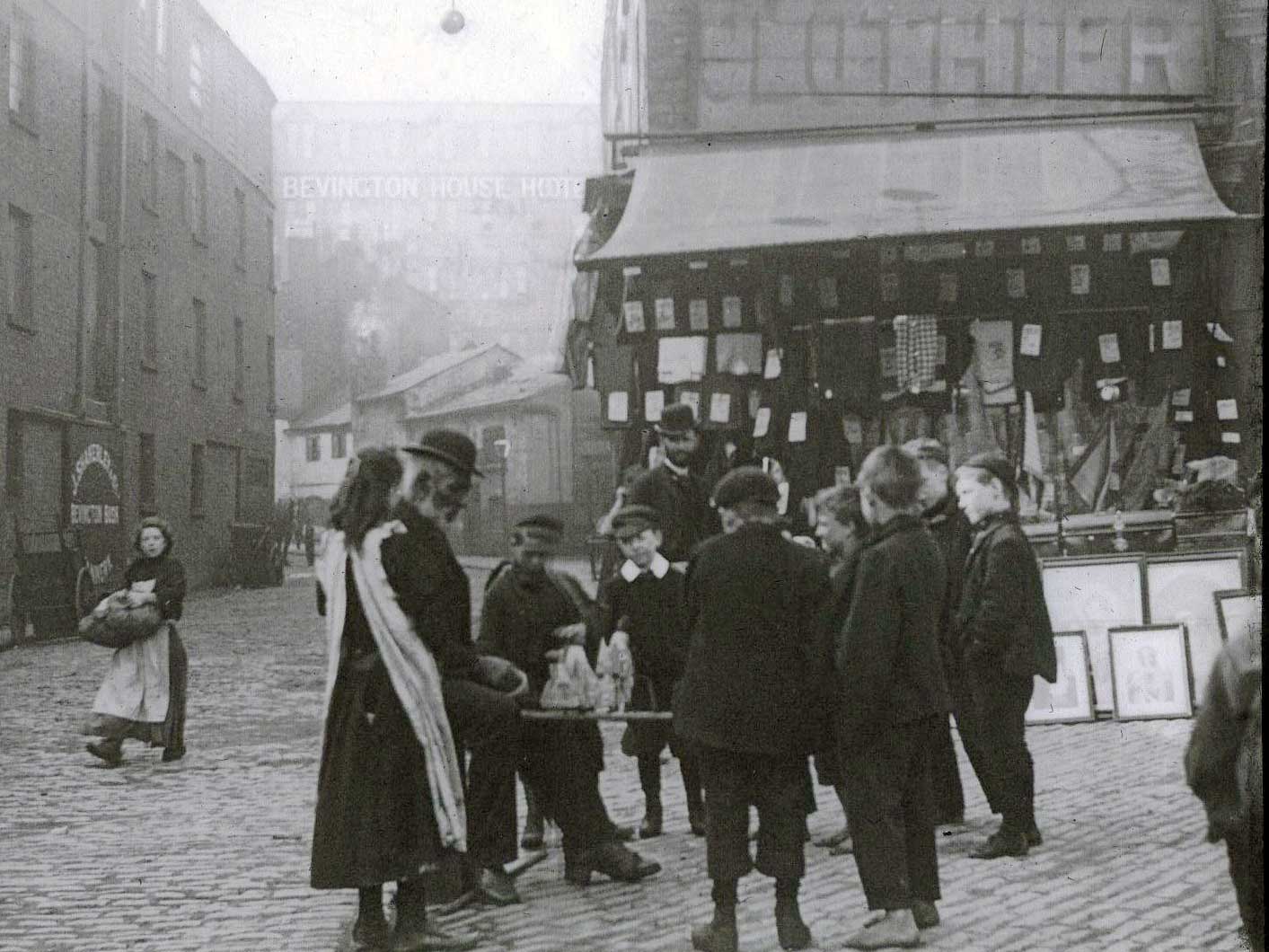
The song is also known by “Whiskey on a Sunday” or “Come Day, Go Day.” Liverpool folksinger Glyn Hughes wrote it in 1959 after hearing stories from older people who remembered seeing Davy in the 1890s.

Originally a sailor from Jamaica, Seth Davy became a fixed character on the streets of Liverpool entertaining, especially young children, dancing his three homemade dolls on a plank. He sang the minstrel song “Massa Is a Stingy Man,” with the chorus, “Sing come day go day, God send Sunday, we’ll drink whiskey all the week, and buttermilk on Sunday.”

The place and idioms in the lyrics reference Liverpool, but Irish singers have sung the song often with words changed to reference Dublin.

Listen to John Roberts and Tony Barrand singing “Seth Davy:”

See English singer Christopher Lawley essentially re-enacting Seth Davy:
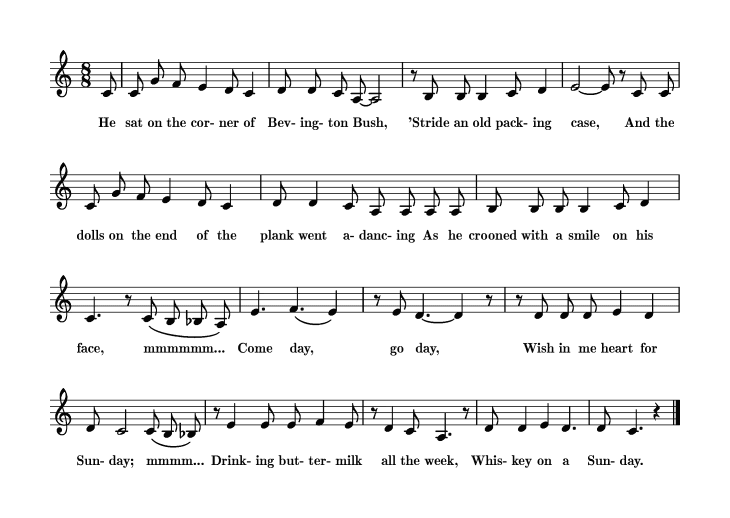
Sheet music for "Seth Davy"
Download the sheet music for “Seth Davy.”

Lyrics: Seth Davy or Come Day, Go Day

By Glyn Hughes

Chorus:
Come day, go day
Wish in my heart for Sunday
Drinking buttermilk all the week
Whiskey on a Sunday.


He sat on the corner of Bevington Bush
Beside an old packing case
And the dolls on the end of his plank went a-dancing
As he crooned with a smile on his face:

The tired old man drummed the wooden beam
His dolls, they danced the gear
A better old show as you’ve ever seen
At the Pivvy or the New Brighton Pier:

In 1902 old Seth Davy died
His song was heard no more
The three dancing dolls in the jowler bin ended
And the plank went to mend the back door:

But on some stormy nights down old Scotty Road way
With the wind blowing in from the sea
You can still hear the song of old Seth Davy
As he croons to his dancing dolls three:

Dave Para is a folksinger from Missouri and now from New Mexico, who with his late wife, Cathy Barton, danced the limberjack for children many, many times. He used information from a Mudcat thread and Secondhand Songs for this article.
Submitted by Sara Grey

“Cobweb of Dreams” was written by Joy Masefield and Leon Rosselson, an English songwriter whose specialty is topical political songs. It is not just the simple love song it first appears to be. In Oxfordshire, England, it was the tradition to present a historical documentary, a combination of drama, music, and light show, of the ancient village of Towersey. “Cobweb of Dreams” was the song which opened and closed the drama, thus binding together the life-cycle of the townspeople of Towersey.

Leon was commissioned to write a love song that was to be sung at the Towersey Festival, and he was very reluctant to do so because he was primarily a writer of political songs and felt uneasy about writing a love song….what a misconception! It turned out to be one of the most poignant and beautiful love songs ever written!

Listen to Sara Grey and the late Ed Trickett performing “Cobweb of Dreams:”

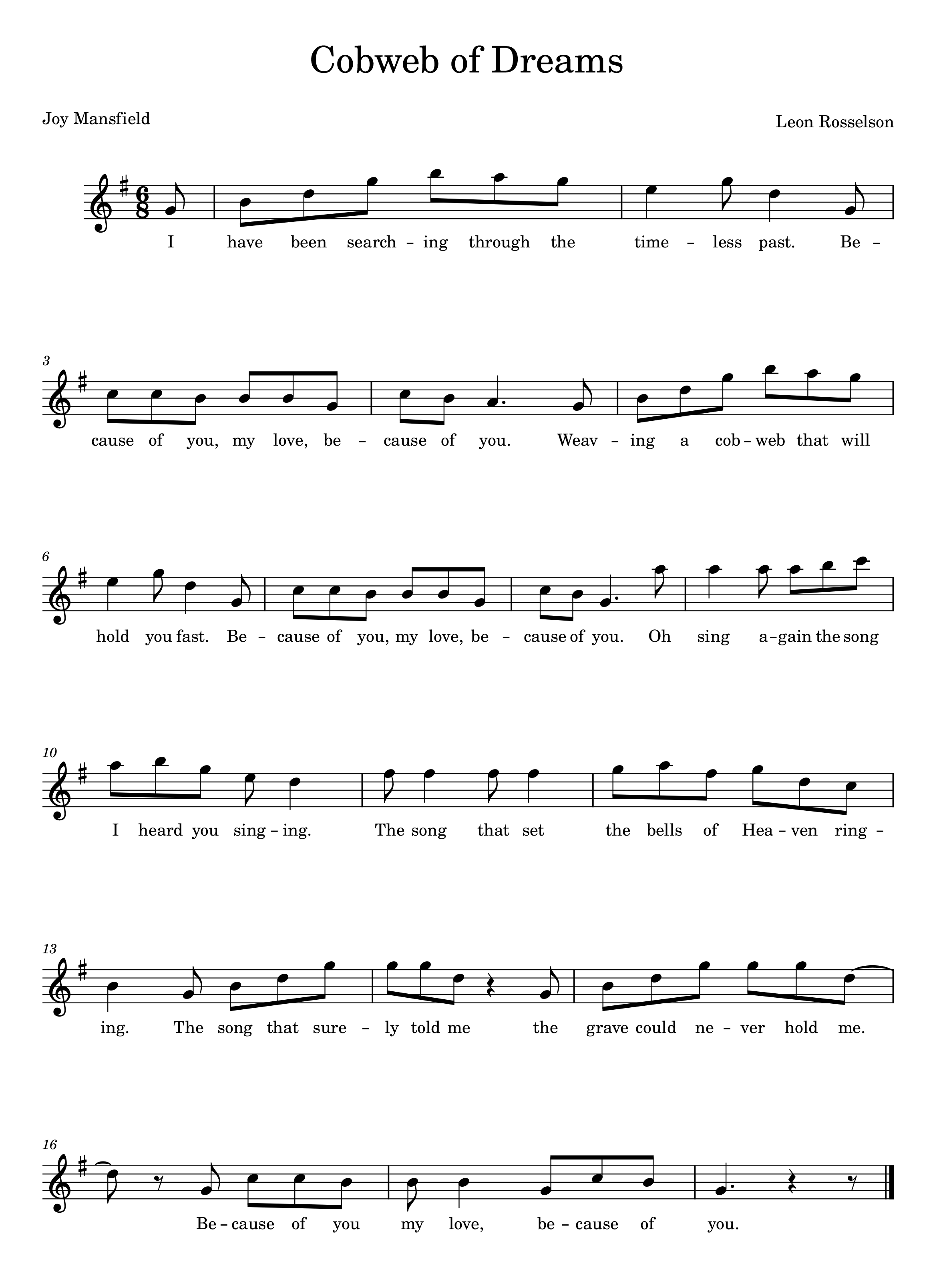
Sheet music for "Cobweb of Dreams"
Download the sheet music for “Cobweb of Dreams.”

Lyrics

Words by Joy Masefield, Music by Leon Rosselson

I have been searching through the timeless past
Because of you, my love, because of you
Weaving a cobweb that will hold you fast
Because of you, my love, because of you.

Oh sing again the song I heard you singing
The song that set the bells of Heaven ringing.
The song that surely told me
The grave could never hold me
Because of you, my love, because of you.

And now I know that love’s a fragile flower
Because of you my love, because of you
So little time between the sun and showers
Because of you, my love, because of you.

Only by singing can I soothe my sorrow
Because of you, my love, because of you.
Today is gone, but there is always tomorrow
Because of you, my love, because of you.

Sara Grey is a fine American singer, banjo player and song collector, who is immersed in the song traditions of both sides of the Atlantic. Her love affair with traditional songs for over 60 years has given her an incomparable knowledge of songs and ballads and how they have moved and evolved. She wants to gather the songs and pass them on to future generations so that they will have the pleasure of hearing and singing them just as she has. After living and singing in Britain for more than 45 years, Sara has returned to her native New England and is living in Vermont with her husband Dave. She continues to tour actively, mostly with her son Kieron Means. See more about Sara on her website.

PDF Flipbook

Special This Issue

Recurring Contributions

Submitted by Mary Garvey

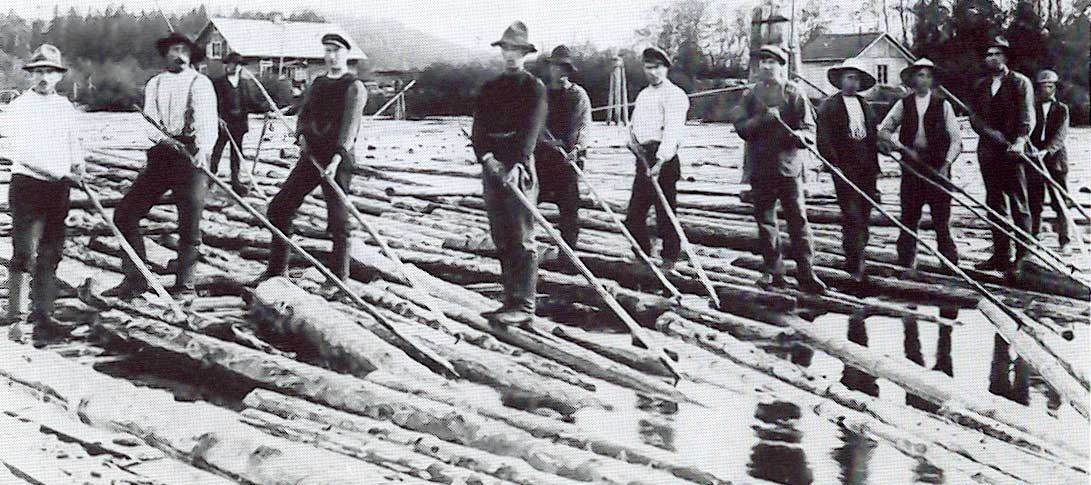
“The Badger Drive” is a Newfoundland folk song/ballad. The song is about a lumber drive near Badger, Newfoundland. As with many Newfoundland ballads, the lyrics are about traditional places and events and sometimes actual individuals—and this song has all those qualities.

The song was composed in 1912 by John V. Devine of King’s Cove, Bonavista Bay, NL. Local and family tradition hold that Devine composed it in a Grand Falls boarding house after having been fired from his job as scaler for the Anglo Newfoundland Development Company (A.N.D.). He sang the song at a St. Patrick’s Day concert at which company officials were present, and allegedly won his job back.

Listen to Barry Delaney performing “The Badger Drive:”

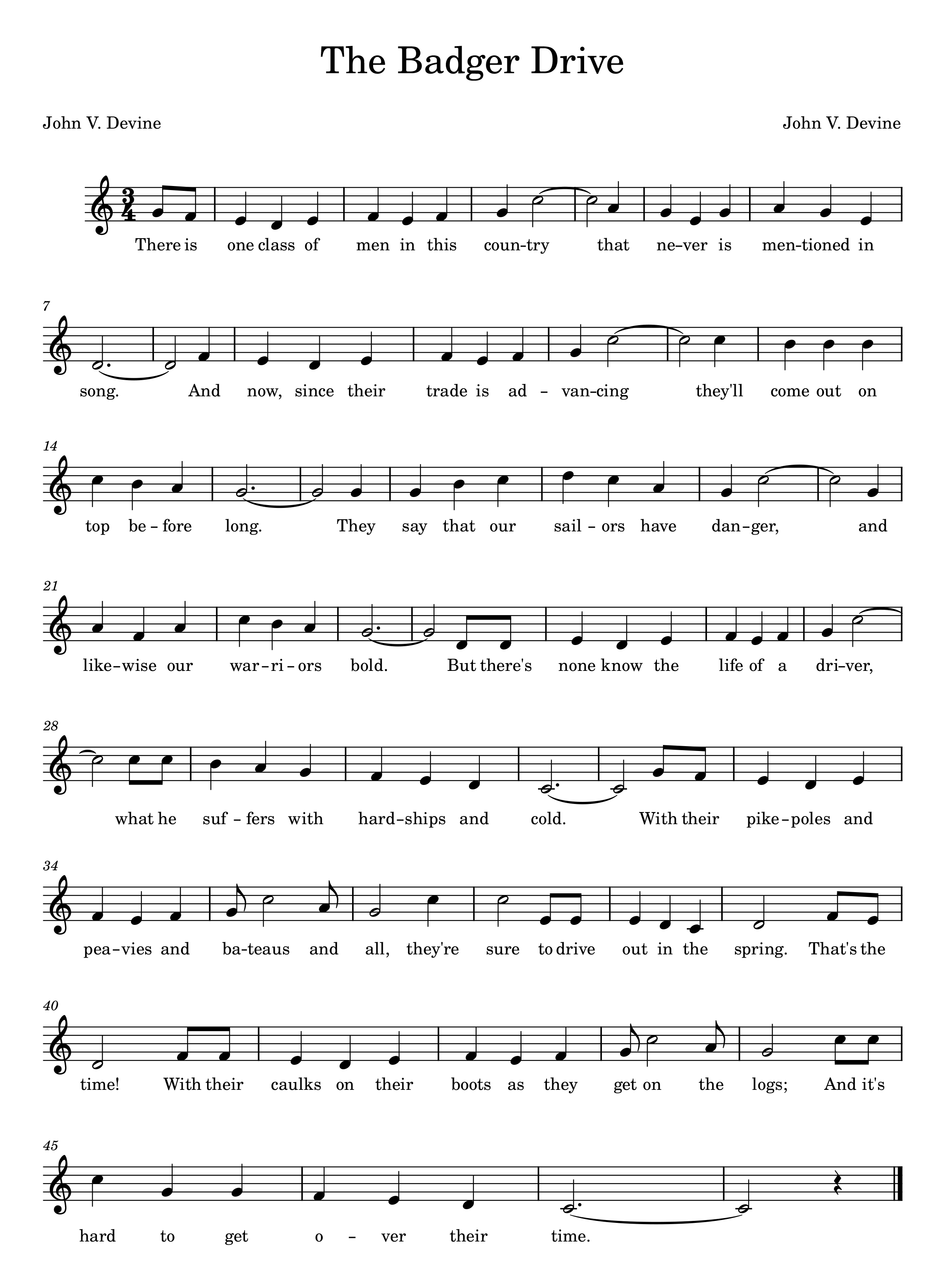
Sheet music for "The Badger Drive"
Download the sheet music for “The Badger Drive.”

Lyrics

There is one class of men in this country that never is mentioned in song.

And now, since their trade is advancing, they’ll come out on top before long.

They say that our sailors have danger, and likewise our warriors bold,

But there’s none know the life of a driver, what he suffers with hardship and cold.

Chorus: 

With their pike poles and peavies and bateaus and all

They’re sure to drive out in the spring, that’s the time

With the caulks on their boots as they get on the logs,

And it’s hard to get over their time.

Bill Dorothey he is the manager, and he’s a good man at the trade;

And when he’s around seeking drivers, he’s like a train going down grade,

But still he is a man that’s kindhearted, on his word you can always depend.

And there’s never a man that works with him but likes to go with him again.

Chorus

I tell you today home in London, The Times it is read by each man,

But little they think of the fellows that drove the wood on Mary Ann,

For paper is made out of pulpwood and many things more you may know,

And long may our men live to drive it upon Paymeoch and Tomjoe.

Chorus

The drive it is just below Badger, and everything is working grand,

With a jolly good crew of picked drivers and Ronald Kelly in command,

For Ronald is boss on the river, and I tell you he’s a man that’s alive,

He drove the wood off Victoria, now he’s out on the main river drive.

Chorus

So now to conclude and to finish, I hope that ye all will agree

In wishing success to all Badger and the A.N.D. Company.

And long may they live for to flourish, and continue to chop, drive and roll,

And long may the business be managed by Mr. Dorothey and Mr. Cole.
Chorus

Mary Garvey writes: I am a retired but still working person originally from the lumber (major log drives here and pulp mills) region of Southwest Washington, USA. I did graduate work in experimental psychology at the University of Newfoundland (unfortunately was unable to complete it) and heard magnificent music there, including in my own house. I have been given a number of songs about my own corner of the world and put out CDs with other people on traditional songs of here (SW WA) and other places. Love Irish and British Isles songs, and Newfoundland songs, of course.  
Submitted by Derek Piotr

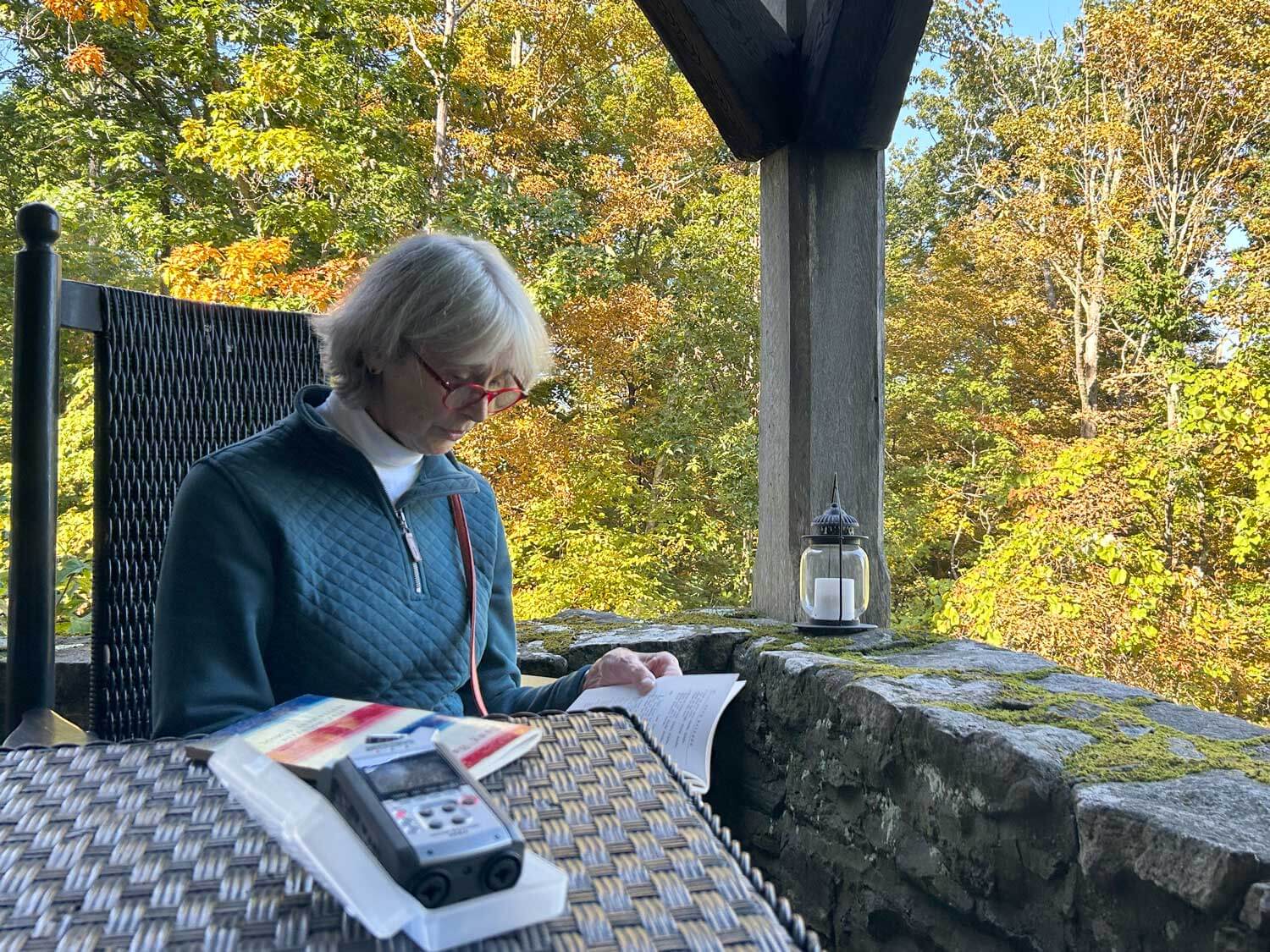
I recently collected a version of “I Wonder When I Shall Be Married” from famed writer Roxana Robinson, at her home in North Cornwall, Connecticut. While the song is primarily attributed to the Ritchie family of Viper, Kentucky, Roxana had learned it from her family in Pine Mountain, and sings it to a different tune.

The song is strangely neutral in tone: the lyrics speak of hope and anticipation, yet the overall tone of the song is melancholic and open-ended.

This song also has the distinction of being the seven hundredth song I have recorded for my Fieldwork Archive!

Hear Roxana Robinson sing “I Wonder When I Shall Be Married:”

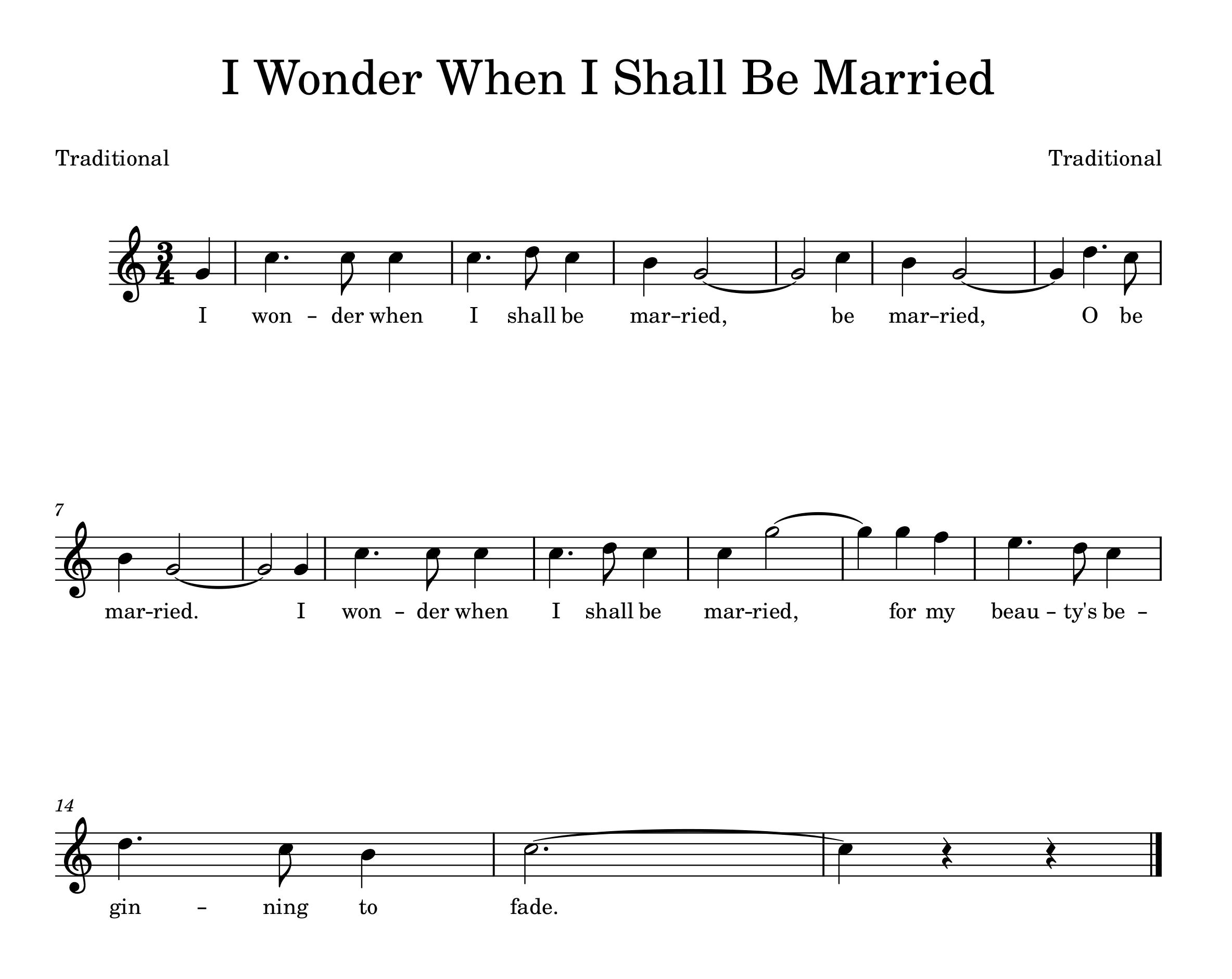
Sheet music for "I Wonder When I Shall Be Married"
Download the sheet music for “I Wonder When I Shall Be Married.”

Lyrics

I wonder when I shall be married,
Be married, O be married,
I wonder when I shall be married,
For my beauty’s beginning to fade.

My mother she is so willing,
So willing, O so willing,
My mother she is so willing,
For she has more daughters than I.

My father has forty good shillings,
Good shillings, O good shillings,
My father has forty good shillings,
And they will be mine when he dies.

My shoes they have gone to be mended,
Be mended, O be mended,
My shoes they have gone to be mended,
And my petticoat gone to dye green.

And they shall be ready by Sunday,
By Sunday, O by Sunday,
And they shall be ready by Sunday,
And then shan’t I look like a queen.

O say, won’t I be a bargain,
A bargain, O a bargain,
O say, won’t I be a bargain,
For someone to carry away.

I wonder when I shall be married,
Be married, O be married,
I wonder when I shall be married,
For my beauty’s beginning to fade.

Derek Piotr is a folklorist, researcher and performer whose work focuses primarily on the human voice. His work covers practices including fieldwork, vocal performance, preservation and autoethnography; and is primarily concerned with tenderness, fragility, beauty and brutality. His work has been supported by The Traditional Song Forum and The Danbury Cultural Commission, and has featured on Death Is Not the End and the BBC. He recently launched the Fieldwork Archive.

Submitted by Andrew Calhoun

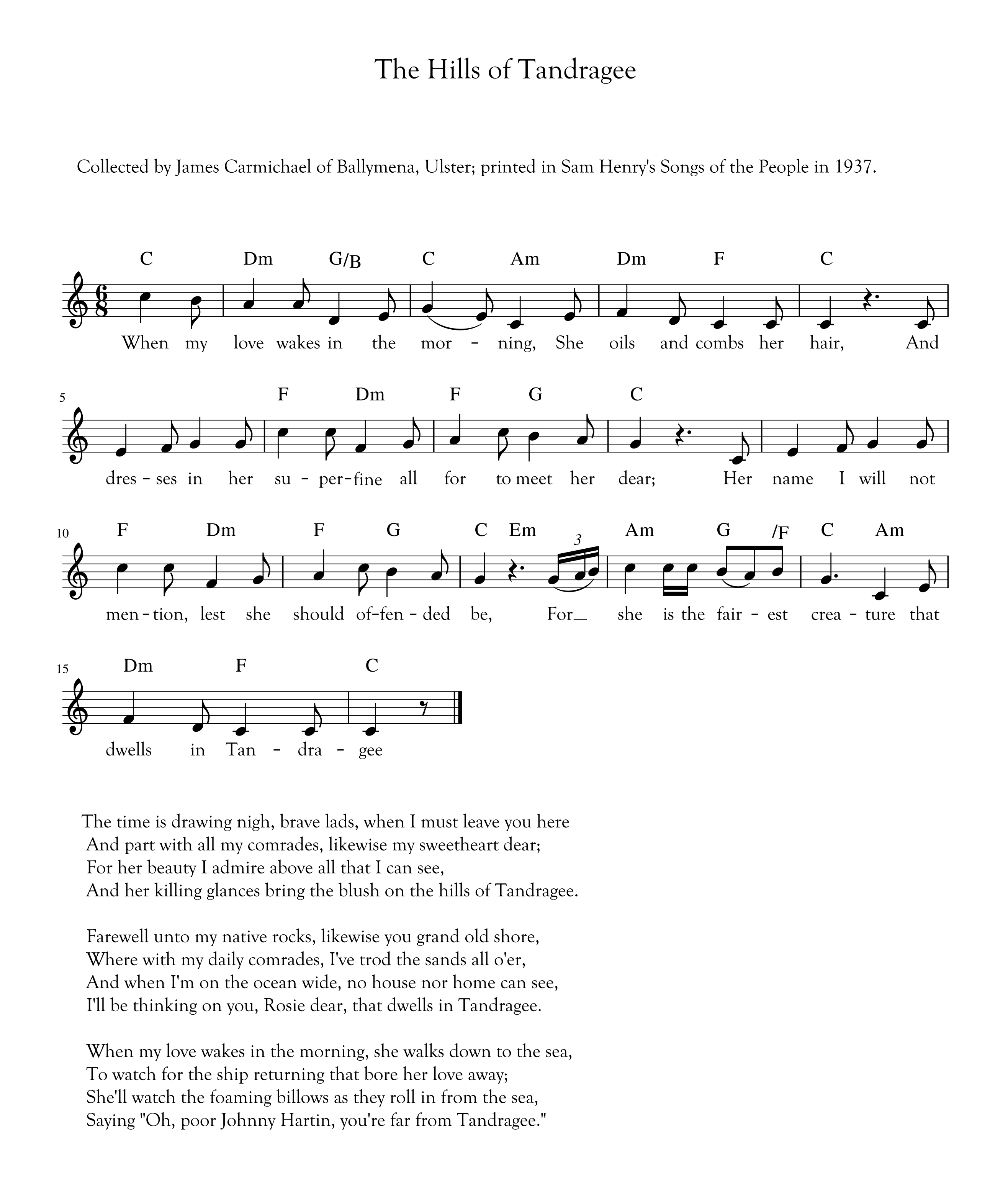
Collected by James Carmichael of Ballymena, Ulster; printed in Sam Henry’s Songs of the People. Arranged by Andrew Calhoun.

Listen to Andrew Calhoun performing “The Hills of Tandragee:”

Sheet music for "The Hills of Tandragee"
Download the sheet music for “The Hills of Tandragee.”

Lyrics

When my love wakes in the morning,
She oils and combs her hair;
And dresses in her superfine
All for to meet her dear.
Her name I will not mention
Lest she should offended be;
For she is the fairest creature
In the hills of Tandragee.

The time is drawing nigh, brave lads,
When I must leave you here;
And part with all my comrades,
Likewise my sweetheart dear.
For her beauty I admire
Above all that I can see;
And her killing glances bring the blush
On the hills of Tandragee.

Farewell unto my native rocks,
Likewise you grand old shore;
Where with my daily comrades,
I’ve trod the sands all o’er.
And when I’m on the ocean wide,
Nor house nor home can see;
I’ll be thinking of you Rosy dear,
That dwells in Tandragee.

When my love wakes in the morning,
She walks down to the sea;
To watch for the ship returning
That bore her love away.
She’ll watch the foaming billows
As they roll in from the sea;
Saying “Oh, poor Johnny Hartin,
You’re far from Tandragee.”

Andrew Calhoun is a gigging singer-songwriter/folk artist since 1975. He founded and managed Waterbug Records, Inc. from 1992–2019. In 2012 he received the Lantern Bearer Award from Folk Alliance Region Midwest; in 2014, a Lifetime Achievement Award from the Woodstock Folk Festival. He’s currently (2023) at work on a Robert Burns songbook called Glorious Work, which will have 410 songs based on research into Burns’s original tunes and texts. Different Now, a CD of 20 old and new original songs, will be released in 2024. 

PDF Flipbook

Special This Issue

Recurring Contributions